The behaviour of a dynamical system could be very complicated,
even we just consider those limiting ones, as chaotic trajectories
could appear. But in the plane, the limiting trajectories on a
compact set have relative simple structures, consisting only
fixed points and closed orbits (that connecting fixed points
or periodic). We have talked about fixed points,
while periodic orbits are much harder to work with than
stationary points, as the explicit expressions are not always available.
In this section, we will describe three aspects:
in the plane:
Poincare-Bendixson Theorem (existence of
periodic solutions)
linearisation: Floquet Theory (solutions of linear ODEs
with periodic coefficients)
and we will show how single periodic orbit could arise from
bifurcation.
4.1 Poincare-Bendixson Theorem
In the plane, there is a classic result called
Poincare Bendixson Theorem
for proving the existence of periodic orbits.
This theorem is stated without proof (can be found in Chapter 6.6 in
the book by Meiss), but you need to be able to state the conditions
correctly and apply it to examples.
Theorem 4.1 (Poincare-Bendixson Theorem for the existence of periodic orbits)
Consider \(\dot x = f(x),x\in\mathbb{R}^2\) and \(f\) smooth. If there exists a
compact (closed and bounded) subset \(\mathcal{D}\subset \mathbb{R}^2\) containing no
stationary points and \(p \in \mathcal{D}\) such that \(\varphi_t(p)\in D\) for all \(t
\ge 0\) (i.e, \(\mathcal{D}\) is invariant), then there is at least one
periodic orbit in \(\mathcal{D}\) and the orbit of \(p\) tends to this periodic orbit.
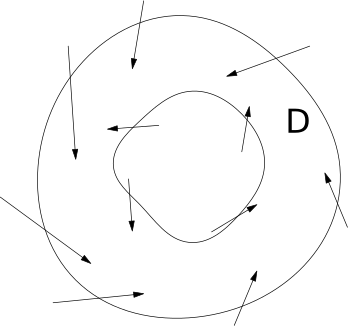
Figure 4.1 Typical Poincare-Bendixson region.
|
How do we apply the theorem? In applications the region
\(\mathcal{D}\) is usually annular (as show in Figure 4.1.
The strategy will be to show that solutions enter and do not leave
an annular region containing no stationary points, hence we can apply the
Poincare-Bendixson Theorem stated above. This is usually done
by constructing a region lying between two closed curves
\(\partial \mathcal{D}_\pm\) defined by \(V_\pm (x)=c_\pm\) with
\(\partial \mathcal{D}_-\) lying inside \(\partial \mathcal{D}_+\) and
\(V_\pm\) increasing outwards (like Lyapunov functions). If in addition
(for example) \(\dot V_-(x)>0\) on \(V_-(x)=c_-\) and \(\dot V_+(x)<0\) on \(V_+(x)=c_+\) then trajectories on both boundaries point into the region and trajectories inside the region cannot cross outwards.
The function \(V\) is not unique, and many functions could
lead to the same conclusion (of course the annular region \(\mathcal{D}\)
could be different). However, a good choice of the function \(V\) can enormously
simplify your calculation, motivated from the corresponding
normal form.
Example 4.1
Consider the system
\begin{align*}
\dot{x} &= x + y - 4x(x^2 +y^2) \\
\dot{y} &= -x + y - 4y(x^2 +y^2)
\end{align*}
The stationary Point \((0,0)\) is obvious. Are there any others?
From the first equation
\[
4x(x^2+y^2) = x+y \quad \text{ i.e. } 4xy(x^2+y^2) = xy + y^2 \]
and from the the second equation
\[
4y(x^2+y^2) = -x+y \quad \text{ i.e. } 4xy(x^2+y^2) = -x^2 + xy \]
Therefore,
\[
4xy(x^2+y^2) = xy + y^2 = -x^2 + xy,
\]
which implies that \(x^2+y^2=0\), or there is no solutions other than \((0,0).\)
Now consider \(V(x,y)=\frac{1}{2}x^2 + \frac{1}{2}y^2\) (can
your think of any motivation for this choice?). Then
\begin{align}\label{eq:itV}
\dot{V} &= x \dot{x} + y \dot{y} \cr
&= x(x+y-4x(x^2+y^2)) + y (-x + y -4y(x^2+y^2)\cr
&= x^2 + y^2 -4(x^2+y^2)^2.
\end{align}
Define
\[
\mathcal{D}=\left\{ (x,y) ~|~ \frac{1}{8} \le x^2 + y^2 \le 1 \right\}.
\]
Then \(\dot{V}>0\) on \( x^2 + y^2 =\frac{1}{8}\) (which is the set
\(V(x,y)=\frac{1}{16}\)) i.e. solutions enter \(\mathcal{D}\) across this
boundary; \(\dot{V}<0\) on \( x^2 + y^2=1\) (which is the set \(V(x,y)=\frac{1}{2}\)) i.e. solutions enter \(\mathcal{D}\) across this boundary. So solutions enter and do not leave \(\mathcal{D}\) which is closed, bounded and contains no stationary points, and hence there is at least one periodic orbit in \(\mathcal{D}\). (Note that any
outer boundary bigger than \(\frac{1}{4}\) and lower boundary less
than this will do.)
In polar coordinates this example is easy:
\begin{align*}
\dot{r} = r(1-4r^2),\qquad \dot{\theta}= -1.
\end{align*}
Thus the \(\dot{\theta}\) equation shows that \((0,0)\) is the only
stationary point, whilst the \(\dot{r}\) equation shows \(r \to \frac{1}{2}\)!
Equivalently we could have noted that the equation for \(\dot V\) in (\ref{eq:itV}) can be written as
\[
\dot V=2V(1-8V).
\]
So solutions \(V = \frac{1}{2}r^2 \to \frac{1}{8}\).
If the boundaries are given by \(V(x)=c\), \(x\in\mathbb{R}^2\), and \(V\) increases
outwards then \(\dot{V}= \nabla V\cdot f(x) \) (by the Chain Rule) and so if \(\dot V>0 \) on the inner boundary then \(f\) points \textbf{into} \(\mathcal{D}\) on the lower boundary and if \(\dot V<0 \) on the outer boundary then \(f\) also points \textbf{into} \(\mathcal{D}\) on the outer boundary. The region \(\mathcal{D}\) is a \underline{trapping region} (no solutions escape from \(\mathcal{D}\)). This can be proved rigorously using the Mean Value Theorem as in sections on Lyapunov functions, but this geometric description is self-evident and does not really need further explication. What if \(\dot{V} \ge 0\) on the outer boundary and \(\dot{V} \le 0\) on the inner boundary (i.e, with non-strict inequalities)? Here the geometric argument does not hold (trajectories can be tangent to the boundary at some places) and we need to work a little harder. If we choose \[ \mathcal{D}=\left\{ (x,y) ~|~ \frac{1}{4} \le x^2 + y^2 \le 1 \right\} \] in the previous example, then \(\dot{V}\geq 0\) (actually \(\dot{V}\equiv0\)) on \(\partial\mathcal{D}_-=\{(x,y)\mid x^2+y^2=1/4\}\). In this case \(\partial \mathcal{D}_-\) is exactly the periodic orbit.
Example 4.2
Prove existence of a periodic orbit for
\begin{align}\label{eq:diffpode}
\dot{x} = y, \qquad
\dot{y} = -x + y (1-3x^2 -6y^2) .
\end{align}
First consider stationary points: from
\(\dot{x}=0\) we find \(y =0\) and then \(\dot{y} = 0\) implies \(x = 0\) so \((0,0)\) is a unique stationary point.
Try \(V(x,y)=x^2 + y^2\), then
\begin{align*}
\dot{V} = 2x \dot{x} + 2 y \dot{y}
= 2xy + 2y \left[ -x + y (1-3x^2 -6y^2)\right]
= 2y^2 (1-3x^2 -6y^2).
\end{align*}
So if \(1-3x^2 -6y^2 <0\) (i.e. in the neighbourhood of the origin), \(\dot{V} \le 0\), and if \(1-3x^2 -6y^2>0\) (i.e. far away from the
origin), \(\dot{V} \ge 0\).
To apply the Poincar\'e-Bendixson Theorem, we have to understand
how the geometry of these ellipses \(\{(x,y)\mid
1-3x^2-6y^2=0\}\) describing the sign of \(\dot V\)
interacts with the geometry of the circles of constant \(V(x,y)=x^2+y^2\) that will
be used to define \(\mathcal{D}\). Moreover, every such circle contains
some points on the \(x\)-axis (with \(y=0\)), and \(\dot V=0\) on some parts of
\(V=c\). As a result, the simple geometric arguments used above will not hold
(we need \(\dot{V}\) strictly less or greater than zero.
How does the \(\dot V\) equation relate to the circles \(V=c\)? First,
\[\dot{V}= 2y^2(1-3x^2-6y^2) \le 2y^2 (1-3x^2-3y^2) \]
So if \(x^2 + y^2 = V \ge \frac{1}{3}\), then \(\dot{V} \le 0 \).
Let the outer boundary of \(\mathcal{D}\) be \(x^2 +y^2 = \frac{1}{3}\),
call this \(\partial \mathcal{D}_+\). Then if \(p=(x_0,y_0)\) with
\(|p| =\sqrt{x_0^2+y_0^2} \le \frac{1}{3}\) and \(V(p) \le \frac{1}{3}\),
we claim \(V(\varphi_t(p))=|\varphi_t(p)|^2 \le \frac{1}{3}\) for all \(t \ge 0\).
Here \(\varphi_t(p)\) is the solution to~\eqref{eq:diffpode} starting
from \(p\) at time \(t=0\) (this form is used to emphasise the
dependence of the initial condition on \(p\)).
Suppose this claim is not true, then there exist two
times \(t_0\) and \(t_1\), such that
\[
V(\varphi_{t_0}(p)) = \frac{1}{3}
\]
and
\[
V(\varphi_t(p)) > \frac{1}{3} \quad \text{ for~ all}\quad t \in (t_0, t_1].\]
In particular
\[ V(\varphi_{t_1}(p))- V(\varphi_{t_0}(p)) >0. \]
Hence by the Mean Value Theorem,
\[
V(\varphi_{t_1}(p, t_1))- V(\varphi_{t_0}(p))=\dot V(\varphi_t(p))(t_1-t_0) \quad
\text{for~some}\quad t\in [t_0,t_1].
\]
On the other hand,
\[ \frac{dV(\varphi_t(p)}{dt} \leq 0 \text{ for all } t
\in \left[ t_0, t_1 \right].
\]
Therefore, \(0 < V(\varphi_{t_1}(p, t_1))- V(\varphi_{t_0}(p))=\dot{V}(\varphi_t(p))(t_1-t_0)\leq 0\), which is a contradiction. Now we consider the inner boundary. The fact \[ \dot{V}=2y^2 (1-3x^2 - 6y^2) \ge 2 y^2 (1-6x^2 - 6y^2)\] implies that \(\dot{V}\geq 0\) on the set \(\{(x,y)\mid x^2+y^2 \leq 1/6\}\), and motivates the choice of the inner boundary \[ \partial \mathcal{D}_{-}=\left\{ (x,y) \mid x^2 + y^2=\frac{1}{6}\right\}. \] We claim that if \(V(p) \ge \frac{1}{6}\) then \(V(\varphi_t(p)) \ge \frac{1}{6}\) for all \(t \ge 0\). The proof is almost exactly the same as the above case (try it!). So if we choose \(\mathcal{D}=\left\{ (x,y) \mid \frac{1}{6} \le V(x,y) \le \frac{1}{3} \right\}\), a solution that starts in \(\mathcal{D}\) stays in \(\mathcal{D}\). Moreover, \(\mathcal{D}\) contains no stationary points and hence by the Poincar\'e-Bendixson Theorem there is at least one periodic orbit in \(\mathcal{D}\).
Now we consider a much more complicated example, in which
the Poincar\'e-Bendixson region is much more difficult to construct.
Example 4.3 (Glycolysis oscillation)
In this system of ODEs modelling the process how the human body converts
glucose (sugar) into energy, \(x\) is the ADP concentration and \(y\) is the
F6P (fructose-t-phosphate) concentration \((a>0)\):
\[
\dot{x}= -x + ay +x^2 y, \qquad
\dot{y}= \frac{1}{2} - ay -x^2 y.
\]
We want to show that there are oscillations (periodic orbits)
if the positive parameter \(a\) is sufficiently small.
Start by considering stationary points and their stability.
\emph{Stationary Points}: Solving the system
\[
x^2 y = x-ay,\qquad
x^2 y = \frac{1}{2}-ay,
\]
we get \(x^*= \frac{1}{2}\) and
\( y^* = \frac{1}{2(a+x^2)}= \frac{2}{4a+1}\).
So \(\left(\frac{1}{2}, \frac{2}{4a+1}\right)\) is the only stationary point.
\emph{Stability}: The Jacobian matrix is
\[ J= \begin{pmatrix}
-1 + 2xy & x^2 + a \\ -2xy & -(x^2+a)
\end{pmatrix}.\]
At the stationary point \(\left(\frac{1}{2}, \frac{2}{4a+1}\right)\),
\[ J(x^*, y^*) = \begin{pmatrix}
-1 + y^* & \frac{1}{2y^*} \\ -y^* & -\frac{1}{2y^*}
\end{pmatrix}.\]
Therefore, we get the determinant and the trace
\[
\det J = \frac{1}{2y^*} >0,\quad
\mbox{tr} J = -1+y^*-\frac{1}{2y^*}.
\]
Since the product of the roots (\({\rm det}J\)) is positive the stationary point is not a saddle, and so it is stable
if \(\text{ Tr } J < 0\) and unstable if \(\text{ Tr } J> 0\).
In other words, the stationary point is unstable if \(1+\frac{1}{2y^*} - y^* < 0\) or \[1+\frac{4a+1}{4} - \frac{2}{4a+1} < 0.\] This equation can be written as \[ 4(4a+1) + (4a+1)^2 - 8 <0 \qquad \mbox{or}\qquad 16a + 4 + 16a^2 + 8a + 1 - 8 <0 \] which is simplified as \[3 - 24a - 16a^2> 0 .\]
Thus if \(a\) is sufficiently small, then the fixed point is unstable
and there is a small closed curve containing the fixed point
that solutions cross outwards.
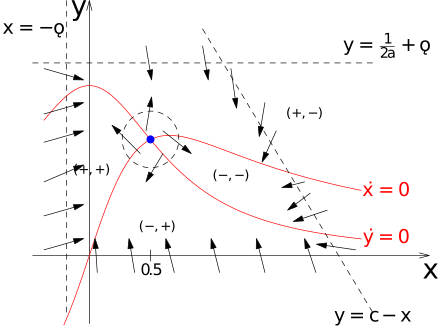
Figure 4.2
Poincare-Bendixson region for the glycolysis model.
Constructing a PB region (when \(a>0\) is sufficiently small):
As noted earlier, if \(a\) is sufficiently small then the stationary point
\((\frac{1}{2}, \frac{2}{1+4a})\) is unstable and so we can use the Lyapunov
function constructed from adjoint eigenvectors in reverse time to construct
an inner boundary that trajectories cross outwards.
In what follows \(\epsilon >0\) is a small constant.
The remainder of the Poincar\'e-Bendixson region will be constructed using
four straight lines (see Figure 4.2): the \(x\)-axis,
a vertical line near the \(y\)-axis, a horizontal line at larger \(y\)
and a part of \(x+y=c\), with \(c\) chosen later. The first two are obvious.
If \(y=0\) (the \(x\)-axis) then \(\dot y= 1/2>0\) and so trajectories cross
the \(x\)-axis upwards into \(y>0\). If \(x=-\epsilon<0\) (near the \(y\)-axis) then \(\dot x=\epsilon +ay\) and so \(\dot x> 0\) if \(y>0\). Thus solutions cross the
\(x\)-axis and a horizontal line near the \(y\)-axis into the positive quadrant
formed by the two lines. (The use of \(\epsilon\) is so that we don't have to
worry about the behaviour at the origin, where \(\dot x=0\) had we chosen the
two coordinate axes.)
To think about the remaining straight lines of the boundary, draw the two
nullclines:
\begin{align*}
y = \frac{x}{a+x^2} \quad \mbox{ on which } \dot{x}=0,\\
y = \frac{1}{2(a+x^2)} \quad \mbox{ on which } \dot{y}=0.
\end{align*}
In other words, the direction field (or the vector field) is
vertical on the line \(y=x/(a+x^2)\) and horizontal on \(y=1/2(a+x^2)\).
Thus the nullcline \(y=1/2(a+x^2)\) for \(\dot{y}\) has a maximum
at \(y=\frac{1}{2a}\); if \(y>\frac{1}{2a}\), then \(\dot y<0\) and trajectories have a component downwards. This suggests using the line \[ y=\frac{1}{2a}+\epsilon \] which all solutions cross downwards. But we can not choose a vertical line \(x=M\) for some large \(M\) to complete the closed region, because of the term \(x^2y\) ( \(\dot{x}\) may not be negative on this vertical line). However, we note that the sign for \(\dot{x}+\dot{y}=-x+1/2\) is much simpler (negative when \(x>1/2\)). This motivate the choice of straight lines
of the form \(x+y=c\) for some \(c\). If we choose \(F(x,y)=x+y-c\)
and define the region \(D=\{ (x,y)\mid F(x,y)<0\), then \(\dot{F}<0\) if \(x>1/2\). In other words, trajectories on the line \(x+y=c\)
cross inwards to \(D\).
The choice of \(c\) is determined by closing the outer boundary as simply as possible: choose it so that \(x+y=c\) intersects \(y=\frac{1}{2a}+\epsilon\) when \(x=\frac{1}{2}\), i.e.
\[
c=\frac{1}{2}+\frac{1}{2a}+\epsilon .
\]
So consider region (see Figure 4.2) bounded by
\(\displaystyle x=0, \qquad 0 \le y \le \frac{1}{2a}+\epsilon \)
\(\displaystyle y=0, \qquad 0 \le x \le \frac{1}{2}+\frac{1}{2a}+\epsilon \)
\(\displaystyle y=\frac{1}{2a}+\epsilon , \qquad 0 \le x \le \frac{1}{2}\)
\(\displaystyle x+y-(\frac{1}{2}+\frac{1}{2a}+\epsilon )=0, \qquad \frac{1}{2} \le x \le \frac{1}{2}+\frac{1}{2a}+\epsilon\)
Solutions enter but do not leave this region bounded by these curves.
Together with the small closed curve about the unstable (\(a\) sufficiently
small) stationary point which solutions cross outwards, this forms a
Poincar\'e-Bendixson region. Hence there exists a periodic orbit.
Another famous system exhibiting periodic solution is the Van der Pol oscillator
\[
\dot{x} = y +x-\frac{x^3}{3},\qquad
\dot{y} = -x.
\]
The construction of the outer invariant boundary turns out to be also much more complicated (see the tutorial exercise).