Applied mathematicians create mathematical models to describe the world. These may involve physics (mechanics), chemistry (reaction kinetics), economics (stock movements, supply and demand), social sciences (voter preferences, opinion formation) or any number of different disciplines and problems. The common thread though is that the model is only useful if it can be used to obtain more insights into the problem being addressed. The methods that can be brought to bear depend on the nature of the model.
Models used to simulate and predict weather or climate could be very complicated, because various processes like heat transfer (both vertically and horizontally) are coupled together on the surfaces of land, ocean and ice. For the fantastically detailed climate models used to assess the probability of climate change the techniques are essentially computational, but mathematics is important in the design of the schemes and the analysis of the data. Climate scientists will also use much cruder models to provide insights into the relative importance of different effects. These models are designed so that more detailed mathematical analysis is possible, and longer, more varied computer simulation as well because the time spent on the computation is so much smaller.
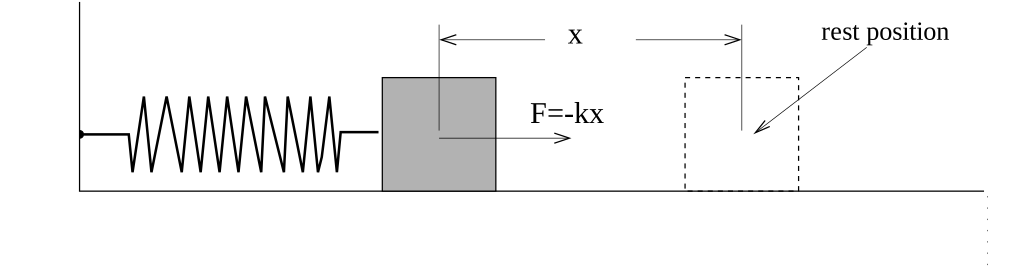
The aim of this course is to describe some of the mathematical techniques that can be used to analyse differential or difference equations that arise frequently in models. Differential equations are used to describe how quantities vary in time (or space). If there is only one independent variable then the model is an ordinary differential equation (ODE) such as \begin{equation}\label{ode} \frac{\mathrm{d}^2x}{\mathrm{d} t^2} + \omega^2 x = 0 \end{equation} with solutions \(x(t)\) that is a function of the continuous, independent variable \(t\) and the initial conditions (if they are specified). This equation describes the motion of an object under the sole force of spring force (see Figure 1.1), governed by the Newton's equation \(m\ddot{x} =F=-kx\). It is sometimes useful to consider time as a discrete variable, leading to difference equations such as the logistic equation \begin{equation} \label{logistic_equation} x_{n+1} = \mu x_n (1 - x_n) \quad \text{ with } ~ \mu \in [0,4]. \end{equation} This generates a sequence \(\{x_0, x_1, x_2, \dots\}\) rather than a function of a continuous variable. We assume you are familiar with basic linear differential equations and difference equations. There are two features that may be new to you (and will be our focus later) in this course: nonlinearity and parameter variation.
Nonlinearity refers to the existence of terms like \(x^2\) in the equation (terms that are not linear in the dependent variable you are seeking). For example, the logistic equation \(\eqref{logistic_equation}\) is nonlinear whilst equations \(\eqref{ode}\) and are linear in \(x\) and \(u\) respectively. In general, nonlinear equations cannot be solved in terms of simple functions, and new techniques are needed to obtain information about solution. In many models these are parameters --- quantities which are constant in any single realisation of the experiment, but which can be changed (like the interest rate set by Bank of England to regulate the economy). In fluid mechanics an example is the Reynolds number of a flow, in chemistry reaction rates depend on ambient temperatures, in social sciences behaviour may be influenced by the average number of friends a person has (and in epidemiology the average number of contacts). Often these parameters are not known accurately and so it is important to know how sensitive any conclusions are to parameter variation. This is described by bifurcation theory: the study of how quantitative changes occur as parameters are varied. The quantity \(\mu\) in the logistic equation is an example of a parameter. Tipping points are another.
Finally, nonlinearity can lead to behaviour that is more complicated than the obvious static and periodic solutions (or more general quasi-periodic solutions). This is called chaos, and one of the interesting features of chaos is that it has its own version of bifurcation theory --- there are a number of common routes to chaos describing how chaotic solutions are created as parameters change. We will discuss some of these too.