Similarly, as the parameter \(\mu\) in the map \(x_{n+1}=f_\mu(x_n)\) varies, bifurcation could occur at the fixed point \(x^*=f_\mu(x^*)\) if \(|f_\mu'(x^*)|\) passes one. To compare with the continuous dynamical systems \(\dot{x} = f_\mu(x)\), we can consider the analogous discrete maps \(x_{n+1} = x_n + f_\mu(x_n)\) (instead of \(x_{n+1}=f_\mu(x_n)\), such that the fixed points in both cases coincide, that is \(f_\mu(x^*)=0\) and the bifurcation diagrams are exactly the same.
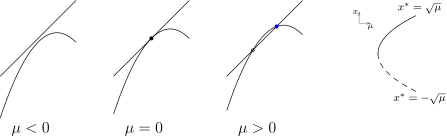
Saddle-node (tangential) bifurcation for \(x_{n+1} = \mu+x_n-x_n^2\): If \(\mu>0\), there are two fixed points \(x_\pm^* = \pm \mu^{1/2}\) (two intersection points between the curve \(y=x\) and \(y=\mu+x-x^2\)); the fixed point \(x^*_+=\mu^{1/2}\) is stable but \(x^*_-=-\mu^{1/2}\) is not stable. If \(\mu<0\), there is no fixed point. Because bifurcation occurs when the straight line \(y=x\) touches the parabola \(y=\mu+x-x^2\) tangentially at \(\mu=0\), this saddle-node bifurcation is also called tangential bifurcation (see Figure 6.3).
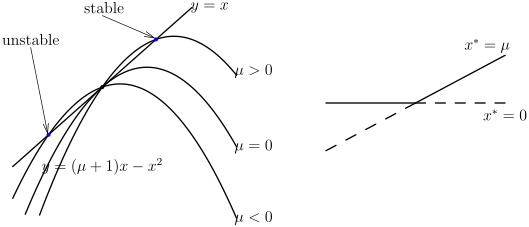
Transcritical bifurcation for \(x_{n+1} = (1+\mu)x_n-x_n^2\): There are always two fixed points \(x^*=0\) and \(x^*=\mu\). The fixed point \(x^*=0\) is stable for \(\mu<0\), but becomes unstable for \(\mu>0\), while the other fixed point \(x^*=\mu\) is stable.
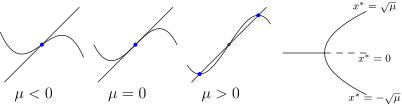
Supercritical pitchfork bifurcation for \(x_{n+1} = (1+\mu)x_n-x_n^3\): When \(\mu<0\), there is only one fixed point \(x^*=0\), which is stable. When \(\mu>0\), there are three fixed points; \(x^*=\pm \mu^{1/2}\) are stable, but \(x^*=0\) unstable.
For continuous dynamical systems, Hopf bifurcation is common when stable spiral becomes unstable spiral (real parts of the eigenvalue becomes positive), and periodic solution appears. For maps, the analogous situation is period-two bifurcation: the original fixed point becomes unstable, and a period-two orbit appear. This will be examined in the next subsection, for the special logistic map.
Move the slider to choose different values of \(\mu\) in the well-known logistic map \[ x_{n+1} = \mu x_n(1-x_n). \] We will study the first few bifurcation points in the next section.