Suppose that after a change of coordinate transformation,
the hyperplane (or line, if \(x\) is one dimension) \((x,0)\) is spanned by \(E^c\)
and \((0,y)\) by \(E^s\), then the centre manifold is tangential
to \(y=0\) at \((0,0)\) and we may assume that
\[
W^c =\big\{ (x,y)~ | ~y=h(x), h(0)=0, Dh(0)=0 \big\}.
\]
In this coordinate, the system can be written as
\[
\dot{x}= Ax + f_1 (x,y),\qquad \dot{y}= Cy + f_2 (x,y),
\]
where all eigenvalues of \(A\) have real parts zero and those of \(C\) have real parts non-zero, \(f_i\) contain only nonlinear terms.
So on the centre manifold \(W^c\),
\[\dot{x}= Ax + f_1 (x,h(x)) \]
and \(\dot y\) can be calculated on the centre manifold in two ways: directly from the \(\dot y\) equation above, or by differentiating \(y=h(x)\), i.e.
\[
\dot{y} = Ch(x) + f_2(x, h(x)) \qquad \mbox{and} \qquad
\dot{y} =\frac{d}{dt}h(x) = Dh(x)\dot x = Dh(x)\left[ Ax + f_1 (x,h(x)) \right].
\]
where \(Dh(x)\) is the (matrix) partial derivatives of \(h(x)\), in one dimension simply
\(h'(x)\).
Expanding \(h\) as a Taylor series (noting that the constant and linear terms
vanish), the two equations for \(\dot y\) provide two different polynomials
and the coefficients of different monomials can be equated to determine
the coefficients of the Taylor expansion.
For a specific problem, here is the general procedure to calculate the centre manifold (which
is very similar if you want to find the stable/unstable manifold):
Change the system into normal form (if needed), such that the linearised system
is a diagonal matrix
Identify the centre manifold \(E^c\) of the linearised system, which is the linear space
spanned by the eigenvectors associated with the zero eigenvalues.
Parameterise the centre manifold. You can parameterised \(E^c\) first, and then
for \(W^c\). For instance, if \(E^c\) is the \(y\)-axis, then \(E^c\) is parameterised as
\(x=0\) (and \(z=0\) if in three dimension), and \(W^c\) (also a line!)
is parameterised by \(x=a_2y^2+a_3y^3+\cdots\) and \(z=b_2y^2+b_3y^3+\cdots\). If \(E^c\)
is the \(xy\)-plane in three dimension, then \(E^c\) is parameterised by \(z=0\) and \(W^c\) is
parameterised by
\[
z = ax^2+bxy+cy^2+\cdots.
\]
Finally determine the coefficients in the parmaterisation by differentiation on both sides.
Example 5.2
Consider the system
\[
\dot{x} = xy,\quad
\dot{y} = -y - x^2.
\]
The linear normal form (based on the linearisation at the origin)
has the constant matrix
\[
A = \begin{pmatrix}
0 & 0 \\ 0 & 1
\end{pmatrix}
= \mbox{diag} \; (0, -1).
\]
Then the eigenpairs are
\[
\lambda_1 = 0, e_1 = \begin{pmatrix} 1 \cr 0 \end{pmatrix},\qquad
\lambda_2 = -1, e_2 = \begin{pmatrix} 0 \cr 1 \end{pmatrix}.
\]
Since the matrix \(A\) is already in normal form, no coordinate transformation is needed.
Now the centre manifold takes the form
\begin{equation}\label{eqwc}
y = h(x)=a x^2 + b x^3 + c x^4 + O(x^5),
\end{equation}
There is no constant term, because the centre manifold passes through the origin;
there is no linear term, because this manifold should be tangent to \(e_1\) (or equivalently \(E^c\),
the centre manifold of the linearised system).
We can determine the coefficients by comparing
two ways for calculating \(\dot y\). Directly from the \(\dot y \) equation
of the system
\begin{equation}\label{eqyc}
\dot{y} = -y - x^2 =-(a x^2 + b x^3 + c x^4) -x^2+O(x^5).
\end{equation}
On the other hand, differentiating (\ref{eqwc}) w.r.t \(t\) gives
\(\dot{y} = d{h(x)}/{dt} = \dot{x} h'(x)\), i.e.,
\begin{equation}\label{eqhc}
x(ax^2+bx^3+cx^4+\cdots)(2ax+3bx^2+4cx^3+\cdots)
= 2ax^4 + \cdots.
\end{equation}
Equating coefficients of \(x^2\), \(x^3\) and \(x^4\) in (\ref{eqyc}) and (\ref{eqhc}) gives
\[
-a-1=0, \quad -b=0, \quad -c=2a^2,
\]
i.e. \(a=-1\), \(b=0\) and \(c=-2\).
Thus the centre manifold is \(y=-x^2-2x^4+O(x^5)\) and the dynamics on
the centre manifold is
\[
\dot x = xh(x)=-x^3-2x^5+O(x^7) .
\]
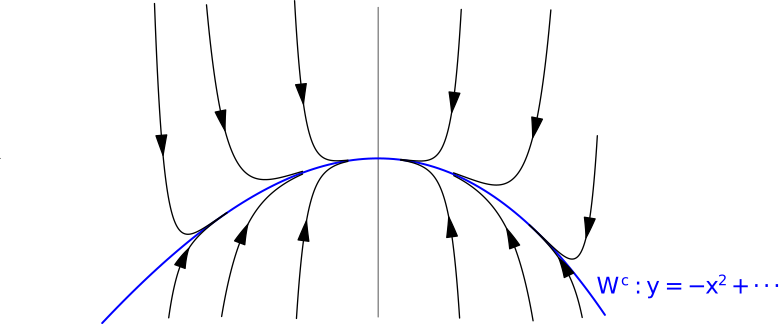
Thus \(\dot x <0\) if \(x>0\) and \(\dot x >0\) if \(x<0\). So the origin is stable and the solutions look like a stable node, but the motion onto the centre manifold in the \(y\)-direction is much faster than the motion on the centre manifold, leading to a phase portrait as shown in Figure 5.4. Figure 5.4
Phase portrait showing exponential collapse onto the centre manifold and then slow motion towards \((0,0)\) on the centre manifold.
If you try higher order terms, you get
\[
y = -x^2-2x^4-12x^6-112x^8-1360x^{10}-19872x^{12}+\cdots.
\]
The fast increasing of the coefficients implies that this approximation is
valid only in a small neighbourhood of the origin.
The interactive simulation shows the dynamics
\(\dot{x} = xy,\dot{y}=-y-x^2\) discussed above.
In general, the points converge to the centre manifold quickly, and the
stability of the system is determined by the (reduced) slow dynamics on the
centre manifold.
Example 5.3
Consider the system
\[
\dot{x} = y-x+xy,\qquad \dot{y} = x-y-x^2.
\]
First we have to convert the linearised system
\[
\begin{pmatrix} \dot{x} \cr \dot{y} \end{pmatrix} = A
\begin{pmatrix} x \cr y\end{pmatrix},\qquad
A = \begin{pmatrix} -1 & 1 \cr 1 & -1 \end{pmatrix}
\]
into normal form. It is easy to calculate the eigenpairs of \(A\),
\[
\lambda_1 = 0,\quad e_1=\begin{pmatrix} 1 \cr 1 \end{pmatrix},\quad
\lambda_2 = -2, \quad e_2 = \begin{pmatrix} -1 \cr 1\end{pmatrix}.
% U= [e_1, e_2]^{-1} = \begin{pmatrix}
% 1 & - 1\cr 1 & 1 \end{pmatrix}^{-1}
% =\frac{1}{2}\begin{pmatrix} 1 & 1 \cr -1 & 1\end{pmatrix}.
\]
Let
\[
U=[e_1, e_2]^{-1} =
\begin{pmatrix}
1 & - 1\cr 1 & 1 \end{pmatrix}^{-1}
=\frac{1}{2}\begin{pmatrix} 1 & 1 \cr -1 & 1\end{pmatrix},
\]
the change of variable from \((x,y)\) to \((u,v)\) (in normal form) is
\[
\begin{pmatrix} u \cr v \end{pmatrix}=U
\begin{pmatrix} x \cr y \end{pmatrix} =
\begin{pmatrix} (x+y)/2 \cr (y-x)/2 \end{pmatrix},\qquad
\mbox{or} \qquad
\begin{pmatrix} x \cr y \end{pmatrix} =
U^{-1} \begin{pmatrix} u \cr v \end{pmatrix} =
[e_1,e_2]\begin{pmatrix} u \cr v \end{pmatrix}=
\begin{pmatrix} u-v \cr u+v \end{pmatrix}.
\]
The new system in \((u,v)\) is
\[
\dot{u} = uv-v^2, \dot{v} = -2v+uv-u^2.
\]
The centre manifold is parametrised by \(v=h(u) = au^2+bu^3+cu^4+\cdots\), then
\begin{align*}
\dot{v} &= (2au+3bu^2+4cu^3+\cdots)\dot{u} \cr
& =(2au+3bu^2+4cu^3+\cdots)\big( u(au^2+bu^3+cu^4+\cdots)-(au^2+bu^3+cu^4+\cdots)^2\big) \cr
& = 2a^2u^4+\cdots
\end{align*}
and on the other hand
\begin{align*}
\dot{v} &= -2v+uv-u^2\cr
&= -2(au^2+bu^3+cu^4+\cdots)+u(au^2+bu^3+cu^4+\cdots)-u^2\cr
&=(2a+1)u^2+(2b-a)u^3+(3c-b)u^4+\cdots .
\end{align*}
Comparing the coefficients of \(u^2, u^3\) and \(u^4\) of the two expressions of \(\dot{v}\), we get
\[
a = -\frac{1}{2},\quad b=-\frac{1}{4},\quad c=-\frac{3}{8},\quad \mbox{ or }\quad
v = -\frac{1}{2}u^2-\frac{1}{4}u^3-\frac{3}{8}u^4+\cdots.
\]
The dynamics on the centre manifold is
\[
\dot{u} = uv-v^2 =
-\frac{1}{2}u^3-\frac{1}{4}u^4-\frac{3}{8}u^5+\cdots,
\]
which is stable if \(u\) is small.
Going back to the original coordinates, the centre manifold is approximately
\[
y-x = -\frac{1}{4}(x+y)^2-\frac{1}{16}(x+y)^3-\frac{3}{64}(x+y)^4+\cdots
\]
The calculation could be quite involved if you are calculating unnecessary
higher order terms than needed in the end. In general, the lowest power
appears in equations with stable linear part. For instance, the second expression above starts
with \(u^2\), while the first expression starts with \(u^4\).
Strictly speaking, the change of variables
from \((x,y)\) to \((u,v)\) is not necessary, but we need to know
that the centre manifold is represented as
\[
y-x = a_2(x+y)^2+a_3(x+y)^3+\cdots.
\]
Take the derivative of both sides (w.r.t \(t\)),
\[
\dot{y}-\dot{x} = \big( 2a_2(x+y) + 3a_3(x+y)^2 + \cdots\big)
(\dot{x}+\dot{y}).
\]
After substituting \(\dot{x}\) and \(\dot{y}\), we compare the
coefficients of powers of \((x+y)\) on both sides, and
we should get the same answer. (Probably it is worth the effect
to perform the change of variable at the very beginning).