As it stands, the CMT does not allow us to deal with parameters.
To include the effect of parameters and hence to treat bifurcations, we work on the extended
centre manifolds by augmenting the equation with the apparently trivial equation \(\dot \mu =0\):
\begin{align*}
\dot{x} &= A x + f_1 (x,y,\mu),\\
\dot{y} & = Cy + f_2(x,y,\mu), \\
\dot{\mu} & = 0.
\end{align*}
The additional equation allows us to parametrise the centre manifold as \(y=h(x,\mu)\)
instead of the form \(y=h(x)\) considered in the last section (hence the extended centre manifold).
The trivial equation \(\dot{\mu}=0\) adds one more dimension to the centre manifold and
allows us to work in a neighbourhood of both \((x,y)=(0,0)\) in phase space \emph{and}
\(\mu =0\) in parameter space, where \(\mu=0\) is the value at which the bifurcation occurs.
So \(A\) has the zero real part eigenvalues and \(C\) has stable and unstable manifolds,
and \(f_1, f_2\) contain only nonlinear terms. The CMT gives the motion on the stable
and unstable manifolds,\({W^s}\) and \({W^u}\) in \(y\), and there is a \(n_c + 1\) dimensional
centre manifold (where \(n_c\) is the dimension of \(x\)), valid for \(|x|\) and \(|\mu |\) small.
This time, if coordinates are chosen so that the central motion is in normal form,
the extended centre manifold can be parametrised by \(y=h(x,\mu)\), with
\[
h(0,0)=0, \qquad Dh(0,0) = 0 .
\]
Notice that \(Dh=[D_x h, D_\mu h]\), which is the partial derivative w.r.t both variables.
Then \(\dot{x} = Ax + f_1 (x,h(x,\mu), \mu)\) is the equation on the (extended) centre manifold.
There are three typical equations (to leading order) on the extended centre manifold
if \(A=0\) and \(x\) is a scalar:
\begin{align}\label{basicbifs}
\dot{x} &= \mu - x^2 & {\rm (saddlenode~bifurcation)}\cr
\dot{x} &= \mu x - x^2 & {\rm (transcritical ~bifurcation)}\\
\dot{x} &= \mu x - x^3 & {\rm (pitchfork~bifurcation)}\notag
\end{align}
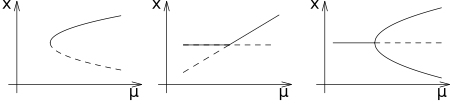
Figure 5.5 \((\mu ,x)\) plane for local bifurcations of stationary points: saddlenode, transcritical and pitchfork (supercritical).
Typical behaviour is sketched in the \((x,\mu )\) plane: these are called
\emph{bifurcation diagrams}. By convention, dotted lines are used to show
unstable solutions and continuous lines for stable solutions. The pitchfork
illustrated her is \emph{supercritical}, meaning that the non-trivial
stationary points are stable; if they were unstable then it would be
a \emph{subcritical} pitchfork bifurcation (a \emph{subcritical} pitchfork bifurcation
when the solid line is dashed, and the dashed line is solid). More details will be given
in the next subsection.
Consider the second order ODE
\[ \ddot{u} + \dot{u} - \mu u + u^2 = 0\]
with a parameter \(\mu\).
Setting \(v=\dot u\), we get the equivalent system of ODEs
\begin{align}\label{eq:extsysm}
\dot{u} = v,\quad
\dot{v} = -v + \mu u - u^2.
\end{align}
At the origin, the matrix for the linear part is \(\begin{pmatrix}
0 & { 1} \\ \mu & -1
\end{pmatrix}\). The eigenvalues satisfies \(s(s+1)-\mu=0\), so
there is a eigenvalue with real part zero, if and only if \(s=0\), or \(\mu=0\).
Therefore we expect a bifurcation at the origin if \(\mu=0\).
\emph{Rough Explanation of what happens for \(\mu\) small}:
The stationary points are governed by \(v=0\), \(\mu u - u^2=0\).
That is \(u=0\), or \(u=\mu\), and we expect a transcritical bifurcation
(exchange of stability).
\emph{The general procedure:}
(a) Transform to normal form (including in the \(\dot \mu=0\) equation);
(b) Expand extended CM;
(c) Calculate dynamics on CM.
\emph{(a). Transformation:} The linear part~\eqref{eq:extsysm} at the origin if
\(\mu=0\) is not in normal (diagonal) form. We have the eigenpairs,
\[
\lambda_1 = 0,\ e_1 = \begin{pmatrix} 1 \cr 0 \end{pmatrix},\quad
\lambda_2 = -1,\ e_2 = \begin{pmatrix} 1 \cr -1 \end{pmatrix}.
\]
Hence the change of coordinate uses the matrix of eigenvectors and the NEW coordinates \(x\), \(y\) are defined by
\[\begin{pmatrix}
u \\ v
\end{pmatrix}= \begin{pmatrix}
1 & 1 \\ 0 & -1
\end{pmatrix}\begin{pmatrix}
x \\ y
\end{pmatrix}
\qquad\mbox{or}\qquad
\begin{pmatrix}
x \\ y
\end{pmatrix}= - \begin{pmatrix}
-1 & -1 \\ 0 & 1
\end{pmatrix}\begin{pmatrix}
u \\ v
\end{pmatrix} = \begin{pmatrix}
1 & 1 \\ 0 & -1
\end{pmatrix}\begin{pmatrix}
u \\ v
\end{pmatrix}\]
Hence the coordinate transform is
\[
x = u + v, \quad
{y} = - v
\qquad
\mbox{or}\qquad
u = x + y, \quad v = - y.
\]
In terms of these new coordinates, the system~\eqref{eq:extsysm} becomes
\begin{align*}
\dot{x} &= \dot{u} + \dot{v} = v - v + \mu u - u^2
= \mu(x+y) - (x+y)^2, \cr
\dot{y} &= - \dot{v} = v - \mu u + u^2
= -y - \mu (x+y) + (x+y)^2.
\end{align*}
\emph{(b). Extended Centre Manifold} Now the extended system in the new coordinates is
\[
\dot{x} = \mu(x+y) - (x+y)^2,\quad
\dot{y} = -y - \mu (x+y) + (x+y)^2,\quad
\dot{\mu} = 0.
\]
The extended centre manifold should be tangential to
the \((x,\mu)\) plane (or \(y=0\)) at \((x,y,\mu )=(0,0,0)\), and is parametrised by
\[y=h(x,\mu )=ax^2 +bx \mu + c \mu^2 + h.o.t. \]
From the \(\dot{y}\) equation
\[\dot{y}= - (ax^2 +bx \mu + c \mu^2 + \dots) - \mu (x + \dots) + x^2 + \cdots
=(1-a)x^2-(b+1)x\mu+\cdots
\]
From the definition of the extended centre manifold
\[\dot y = \frac{\partial h}{\partial x }\dot x + \frac{\partial h}{\partial \mu
} \dot \mu = (2ax+b\mu)\dot{x}
=\cdots,
\]
where all the terms are at least cubic.
So equating coefficients of the quadratic terms (of which there are none in the second equation!)
gives \( a=1\), \(b =-1\), and the extended centre manifold is
\[y=x^2 -x \mu + \dots .\]
\emph{(c). Dynamics on the centre manifold.}
Locally on the extended Centre Manifold \(\dot{\mu}=0\) is trivial so it is the
\(\dot x\) equation that is interesting:
\begin{align*}
\dot{x}
&= \mu(x+x^2 - \mu x + \dots) - (x^2 +2x(x^2 - \mu x) + \dots ) \\
&= \mu x - x^2 + O(x^3)
\end{align*}
Substituting back into the equation for \(\dot x\) we get (to leading order)
\[\underbrace{\dot{x} = \mu x - x^2}_\text{Standard Form for transcritical} + O(x^3).\]
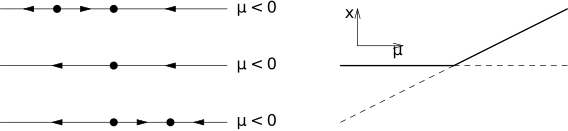
The phase portrait for the reduced dynamics for \(x\) is shown
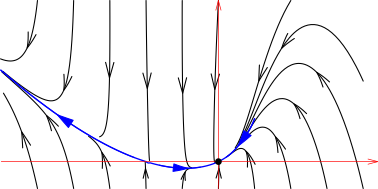
in Figure 5.6 and the phase portrait for the
original system is in Figure 5.7.
Figure 5.6
Phase portraits on the (one-dimensional) centre manifold and the bifurcation diagram.
Figure 5.7
Full phase portraits of the dynamics in \(\mu <0\) and \(\mu >0\).
If the stable manifold is of higher dimension, then
\(y_1 = h_1(x, \mu), y_2 = h_2(x, \mu) \) and we need to find \(h_1, h_2\)
using the same method. For example, for the system
\[
\dot{x} = \mu x - yz,\quad \dot{y} = -y+x^2,\quad \dot{z} = -z+x^3.
\]
Add \(\dot{\mu}=0\) to this system, then the stable manifold
expanded by \(y\) and \(z\) is parameterised by \(x\) and \(\mu\), that is
\[
y=h_1(x,\mu) = a_1 x^2 + a_2 x\mu + a_3 \mu^2+\cdots,\quad
z=h_2(x,\mu) = b_1 x^2 + b_2 x\mu + b_3 \mu^2+\cdots.
\]
Then \(a_1=1, a_2=a_3=b_1=b_2=b_3=0\). That is \(y=x^2+\cdots\), but
we have to go to cubic polynomials to find the stable manifold for \(z\),
which gives \(z=x^3+\cdots\). Therefore, the reduced dynamics on the stable
manifold is
\[
\dot{x} = f_\mu(x) = \mu x - x^5.
\]
If \(\mu<0\), \(x=0\) is the only stable fixed point. If \(\mu>0\), there
are three fixed point \(0, \mu^{1/4}\) and \(-\mu^{1/4}\). Since
\[
f_\mu'(0) = \mu>0, \quad
f_\mu'(\pm \mu^{1/4}) = \mu-5(\pm \mu^{1/4})^4
=-4\mu<0,
\]
the fixed point \(0\) is unstable, and the fixed points \(\pm \mu^{1/4}\)
are stable.