2.3 Special solutions: fixed points and periodic orbits
Special solutions, if they exists, usually give a lot of information about the
general behaviour of the underlying system. There are two obvious special solutions
for \(\dot{x}=f(x)\) arising in practice:
Stationary (or fixed) points: A
stationary point \(x^*\) satisfies \begin{equation}\label{stypt} x(t) \equiv
x^*, \end{equation} i.e. the trajectory is a single point and the solution does not
change in time. Thus \[ 0 = \frac{\mathrm{d}}{\mathrm{d} t}x(t) =
f\big(x(t)\big)=f(x^*), \] and stationary points can be found by solving the algebraic
equation \(f(x^*) = 0\).
Periodic Orbits: if there exists \(T > 0 \) such
that \begin{equation*} x(t+ T) = x(t)\ \text{ for all } t\in\mathbb{R}.
\end{equation*} then the trajectory is called a periodic orbit and \(T\) is called the
period of the periodic orbit. Note that \(kT\) is also a period for any positive
integer \(k\) because \(x(t + kT) = x(t)\), and sometimes \(T\) is referred as the
minimal period). A periodic orbit with \(T=0\), which is not allowed
in the definition, would be a stationary point. Periodic orbits are much harder to
find, and they form closed curves in phase space.
Example 2.10 (Fixed points of linear constant coefficient ODEs) If \(A\) is a non-singular \(n\times n\) matrix, then the only fixed point is the origin. In other words, the only solution to \(Ax=0\) is \(x=0\).
Exercise What if the coefficient matrix \(A\) is singular as in \[ \begin{pmatrix} \dot{x} \cr \dot{y} \end{pmatrix} = \begin{pmatrix} 1 & 0 \cr 0 & 0 \end{pmatrix} \begin{pmatrix} x \cr y \end{pmatrix}. \] Find the solution starting from \((x_0,y_0)\). What are the fixed points?
Example 2.11 (Fixed points of potential dynamics) Consider the Newton's equation \(m\ddot{x} = -\nabla U(x)\) in \(n\)-dimensional space (the force is derived from the potential \(U\)), which is equivalent to the first order system of \(2n\) equations (\(p=m\dot{x}\) is the linear momentum): \[ \dot{x} = \frac{p}{m},\qquad \dot{p} = -\nabla U(x). \] Then any fixed point takes the form \((x^*,p^*=0)\), where \(\nabla U(x^*)=0\). For those who took courses in mechanics, the fixed point is stable if \(x^*\) at the local minimum (bottom of the potential well), and unstable if \(x^*\) is at a saddle point.
Example 2.12 (Harmonic oscillation) The simplest example of periodic phenomenon is the motion of a harmonic oscillator, \(\ddot{x}+\omega^2 x=0\), or the equivalent first order system \[ \dot{x} = y,\qquad \dot{y}= -\omega^2 x. \] The only fixed point is the origin, but there are many periodic orbits around the origin. In fact, the solution can be written as \[ x(t) = A\cos \omega t + B\sin \omega t. \]
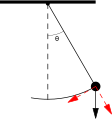
Example 2.13 (Simple Pendulum) Consider the pendulum in
Figure 2.3. By taking components of the force in the radial
direction, the equation of motion is \begin{equation*} \ddot{\theta} +
\frac{g}{\ell}\sin \theta = 0 \end{equation*} or the first order system (by
introducing \(y=\dot{\theta}\)) \begin{align*} \dot{\theta} = y,\qquad \dot{y }= -
\frac{g}{\ell}\sin \theta. \end{align*} So phase space is \(\mathbb{R}^2\), or more
precisely the cylinder \(\mathbb{T}\times\mathbb{R}\) with \(\theta \in [0,2\pi)\)
(here \(\theta\) is taken modulo \(2\pi\)). The solution can not be represented
using elementary functions, but can be given in terms of more special ones called
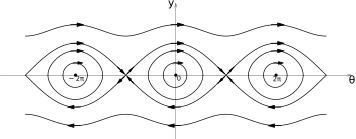
elliptic functions. Stationary points are given by solving
\(\dot{\theta}=\dot{y}=0\), i.e. \(y=0\) and \(\sin \theta = 0\), so the stationary
points are (see Figure 2.3) \begin{equation*} ( k \pi, 0) \quad
k\in\mathbb{Z}. \end{equation*} The only fixed point is the origin, but there are
many periodic orbits around the origin. The simple pendulum equation has special
properties that make it easier to sketch the phase portrait than for more general
systems: the energy (also called Hamiltonian) \begin{equation*} E =
\frac{1}{2} y^2 - \frac{g}{\ell}\cos \theta \end{equation*} is constant on
solutions, which is determined from the initial condition
\((\theta_0,y_0=\dot{\theta}(0))\). This can be seen by differentiating both sides
with respect to time (using the chain rule on the right hand side):
\begin{equation*} \frac{\mathrm{d} E}{\mathrm{d} t} = y \; \dot{y} + \dot{\theta}
\frac{g}{\ell}\sin \theta = \frac{g}{\ell} \left(- y \; \sin \theta + y\; \sin
\theta \right) = 0. \end{equation*}
Figure 2.3: The simple pendulum and associated phase portrait.
Example 2.14 (Prey-predator system) Let \(x\) and \(y\) be the population number of prey (for example, rabbits) and predator (for example, foxes), then the simplest system of ODEs is \begin{equation}\label{eq:preypre} \dot{x} = (A-By)x,\qquad \dot{y} = (Cx-D)y, \end{equation} where \(A,B,C,D\) are all positive constants. The fixed points are \[ (0,0),\qquad \left(\frac{D}{C},\frac{A}{B}\right). \]