For the ODE \(\dot{x}=f(x)\),
a set \(\mathcal{S} \subseteq \mathbb{R}\) is called
invariant, if \(x_0 \in \mathcal{S}\)
implies the solution \(x(t)=\varphi_t(x_0) \in \mathcal{S}\) with initial condition
\(x(0)=\varphi_0(x_0)=x_0\) for all \(t \ge 0\).
The basic idea behind invariant sets is: if you start in the set,
you stay in the set. Common invariant sets include:
Single/multiple stationary points
Periodic orbits
Trajectory passing one or more specific points:
\[
\mathcal{S}_+(x_0) = \{ \varphi_t(x_0)\mid t \geq 0\} \qquad \mbox{or}\qquad
\mathcal{S}(x_0) = \{ \varphi_t(x_0)\mid t \in \mathbb{R}\}.
\]
Example 2.15
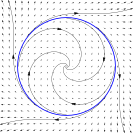
The unit circle \(x^2+y^2=1\) is invariant for
the system
\[
\dot{x} = -x+y+x(x^2+y^2),\qquad
\dot{y} = -x-y+y(x^2+y^2).
\]
In other words, if \((x_0,y_0)\) is on the unit circle, then the solution
is also on the unit circle for any time \(t>0\). Therefore, we only
need to show that \(x^2+y^2\) does not change (always unit), for all time.
Taking the time derivative of \(x^2+y^2\),
\begin{multline*}
\frac{\mathrm{d}}{\mathrm{d} t} (x^2+y^2)
=2x\dot{x} + 2y\dot{y}
=2x\big(-x+y+x(x^2+y^2)\big)\cr
+ 2y\big(-x-y+y(x^2+y^2)\big)
=2(x^2+y^2)(x^2+y^2-1)=0.
\end{multline*}
That is, \(x^2+y^2\) does not change in time if \((x,y)\) is on the circle, and
\(x^2+y^2=1\) for all time.
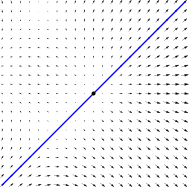
Figure 2.4 Invariant circle for Example 2.15 and invariant
straight line for Example 2.17.
This example shows an important fact: a set \(\mathcal{S} = \{x \mid G(x)=0\}\)
is invariant iff
\begin{equation*}
\frac{\mathrm{d} G}{\mathrm{d} t} = f\cdot\nabla G = 0 \qquad \text{ on }\ G(x)=0.
\end{equation*}
Geometrically, \(\nabla G\) is the normal to the curve \(\mathcal{S}\), and
\(f\cdot\nabla G=0\) means that the vector field defining the ODE is orthogonal to
the normal.
Example 2.16 (Prey-predator system)
The two coordinate axis \(
\mathcal{S}_x =\{ (x,0)\}, \mathcal{S}_y =\{ (0,y)\}\)
are two invariant sets of the system
\[
\dot{x} = (A-By)x,\qquad \dot{y} = (Cx-D)y.
\]
If the initial condition \((x_0,y_0)\) is on the \(x\)-axis, then \(y_0=0\), then
the solution \((x(t),y(t))\) stays on the \(x\)-axis, or \(y(t)\equiv 0\), because
\(\dot{y} \equiv 0\). Alternatively, from the second ODE
\(\dot{y}(t) = (Cx(t)-D)y(t)\), we can ``solve'' \(y(t)\) (assuming \(x(t)\) is known,
this is a linear ODE)
\[
y(t) = y_0\exp\left[\int_0^t (Cx(\tau)-D)\mathrm{d} \tau
\right] = 0.
\]
Therefore, the \(x\)-axis is invariant. Similarly, we can show \(y\)-axis
is invariant.
Example 2.17
We can show that the line \(y=2x\) is invariant under
the system
\[
\dot{x} = \frac{5}{2} x - \frac{1}{2} y + 2 x^2 + \frac{1}{2} y^2,
\qquad
\dot{y} = - x + 2 y + 4xy.
\]
Geometrically, the line \(y=2x\) is a trajectory on the phase portrait.
Define \(G(x,y) = y - 2x\), so the line is \(\mathcal{S}=
\{ (x,y) \mid G(x,y)=0\}\).
We can look at the evolution of the function \(G\) under the system,
\begin{align*}
\dot{G}(x,y) & = \dot{y} - 2 \dot{x} \\
&= (-x + 2y + 4xy) - (5x - y + 4x^2 + y^2) \\
&= -6x + 3y -4x^2 + 4xy - y^2
\end{align*}
If \((x,y)\in \mathcal{S}\), \(G=0\) and \(y=2x\), which implies that
\(\dot{G}|_{G=0} = - 6x + 6x -4 x^2 + 8 x^2 - 4x^2 = 0.\)
Exercise
(1) From the right figure in Figure 2.4, it seems that there is possibly another
invariant straight line going through the origin with with negative slop. Unsing the
method of undertermined coefficients, find whether there is another invariant
straight line of the form \( y = k x\).
(2) Find whether there is a vertical invariant straight line whick takes the form
\(x=x_0\) for some \(x_0\).
(3) Find whether there is a non-vertical invariant straight line of the form
\(y=kx+b\) for some constants \(k\) and \(b\).
In physics, the invariance of a set is generally related to the conservation of some quantities, as shown
in the following three examples.
Example 2.18
(Conservation of energy for Newtonian potential dynamics)
If the force \(F\) of an particle with mass \(m\) is derived from a potential (gravitational potential or electric potential), that is
\(F(x) = \nabla U(x)\) for some \(U\), then the Newton's equation becomes
\(\ddot{x} = F(x) = -\nabla U(x)\). Introduce the (linear) momentum \(p = m\dot{x}\), then the dynamics is governed by the equivalent
first order system
\[
\dot{x} = p/m,\qquad \dot{p} = -\nabla U(x).
\]
Then the total energy (also call Hamiltonian) \(E(x,p) = \dfrac{p^2}{2m} + U(x)\) is conserved,
and the dynamics is on the constant energy surface.
Example 2.19
We can show that the (open) unit disk \(\{ (x,y)\mid x^2+y^2<1\}\) is invariant for the system \[ \dot{x}=-x + y ,\quad \dot{y}=-x-y. \] By the definition, we need to show that if the initial condition \((x_0,y_0)\) is on the unit disk (i.e. \(x_0^2+y_0^2<1\)), then \(x(t)^2+y(t)^2<1\). Since \[ \frac{\mathrm{d} }{\mathrm{d} t} \big( x^2+y^2\big)=2x\dot{x}+2y\dot{y}=2x(-x+y)+2y(-x-y)=-2(x^2+y^2)\leq 0, \] the quantity \(x(t)^2+y(t)^2\) is non-increasing. In other words, \(x(t)^2+y(t)^2\leq x_0^2+y_0^2 <1\). Therefore, the point \((x(t),y(t))\) stays22 on the unit disk.
Example 2.10
(Bounding functions)
The previous example can be generalised into the concept
of bounding functions. Let \(V({x})=c\) be a set of nested regions with \(c\)
increasing outwards, that is \(\{ x\in\mathbb{R}^n \mid V(x) \leq c_1 \} \subset
\{ x \in \mathbb{R}^n \mid V(x) \leq c_2 \}\) for \(c_1 \leq c_2\). If
\begin{equation*}
f \cdot \nabla V < 0 \qquad \text { on }\ V(x)=c \end{equation*} for some \(c\), then the set \(\left\{ x\in\mathbb{R}^n | V(x) \le c \right\}\) is invariant. The idea of the proof is very simple (we will cover it in more detail later): if \(f \cdot \nabla V < 0\) then \(f\) must point inwards along the surface and so no solutions can leave the region \(V < c\) across the surface.