Recall that if \(x=a\) is a stationary point then we use \(x=a+y\), \(|y| \ll 1\)
to change the coordinate to \(y\), such that
\[\dot{y}= {D} f(a) y + O (|y|^2)\]
and linearisation is \(\dot{y}=Ay\), \(A={D}f(a)\) (Jacobian matrix of partial derivatives).
It turns out that nodes, foci and degenerate nodes retain their basic properties under small nonlinear perturbations, so this makes it possible to obtain approximate phase portraits for some systems (ignoring periodic orbits for the moment).
Example 3.4 (ODEs for competitive populations)
Imagine a colony of rabbits (\(r\) and sheep \(s\) with \(r,s\ge 0\) denoting the population size in normalized coordinates so that one unit represents many animals and we are justified in approximating the population size as a continuous variable. A model of the birth/death rates is
\begin{align*}
\dot{r} & = r (3-r-s), \qquad \text{ rabbits} \\
\dot{s} & = s(4 -2r-s), \qquad \text{ sheep}
\end{align*}
where \(s,r \ge 0\).
We can sketch the phase portrait in three stages: first find the stationary points,
then determine their types and the local phase portrait assuming the linear
approximation is valid, and then put this information together to create
a consistent global phase portrait.
Stationary Points:
\(\dot r=0\) if \(r=0\) or \(r+s=3\) whilst \(\dot s =0\) if \(s=0\) or \(2r+s=4\). Hence the stationary points are
\begin{align*}
r & = 0, \; \; s=0, \qquad \qquad (0,0) \\
r & = 0, \; \; s=4, \qquad \qquad (0,4) \\
s & = 0, \; \; r=3, \qquad \qquad (3,0)
\end{align*}
together with the solution of the simultaneous equations
\[
r+s = 3, \qquad
2r+ s = 4
\]
if they exist. Solving gives a fourth stationary point, \(r=1\) and \(s=2\), i.e. \((1,2)\).
Note that the \(r\)-axis and the \(s\)-axis are invariant.
Linearisation:
\[
{D} f(\underline{x}) = \begin{pmatrix} 3 - 2r - s & -r \\ -2s & 4-2r-2s \\ \end{pmatrix}
\]
At \((0,0):\)
\[
{D} f(0,0)= \begin{pmatrix} 3& 0 \\ 0&4 \\ \end{pmatrix}.
\]
The eigenvalues are \(3\) and \(4\) with eigenvectors
\(\begin{pmatrix} 1 \cr 0 \end{pmatrix}\)
and \(\begin{pmatrix} 0 \cr 1 \end{pmatrix}\) respectively, so it
is an unstable node, with almost all solutions tangential to the
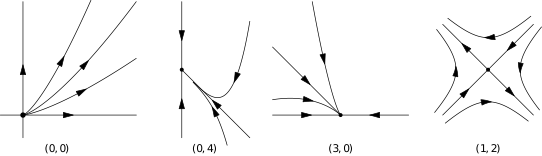
\(r\)-axis and the local solution is as sketched in Figure 3.11).
Figure 3.11
Local phase portraits near each of the stationary points.
At \((0,4):\)
\({D} f(0,4)= \begin{pmatrix} -1& 0 \\ -8& -4 \\ \end{pmatrix} \)
The eigenvalues are \(-1,-4\) so it is a stable node. The
eigenvectors are \( e_{-1}=\begin{pmatrix} 3 \cr {-8}
\end{pmatrix}\) and \(\begin{pmatrix} 0 \cr 1\end{pmatrix}\)
respectively, so almost all solutions are tangential to
\( e_{-1}\) at the stationary point. See Figure 3.11.
At \((3,0):\)
\({D} f(3,0)= \begin{pmatrix} -3& -3 \\ 0& -2 \\ \end{pmatrix} \)
so the eigenvalues are \(-3\) with eigenvector
\(\begin{pmatrix} 1 \cr 0 \end{pmatrix}\) and
\(-2\) with eigenvector \(e_2\begin{pmatrix} {-3}\cr 1
\end{pmatrix}\). So it is a stable node and almost all solutions are tangential to \(e_{2}\) at the stationary point.
At \((1,2):\)
\({D} f(1,2)= \begin{pmatrix} -1& -1 \\ -4&-2 \\ \end{pmatrix} \)
so the characteristic equation is \((s+1)(s+2)-4=0\)
or \(s^2 + 3s - 2 = 0\), i.e.
\(s_\pm = \frac{-3 \pm \sqrt{17}}{2}\).
Since \(s_{+}>0\) and \(s_{-}<0\) is a saddle and the eigenvectors are \(e_\pm=\begin{pmatrix} {-1} \cr {s_\pm+1} \end{pmatrix}\), so \(e_+\) slopes downwards and \(e_-\) slopes upwards.
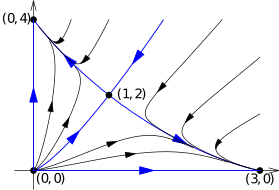
Figure 3.12
Consistent global phase portrait in \(r,s\ge 0\). Note the role of the separatrices in separating regions of initial conditions tending to each of the two stable nodes.
Putting the information together suggests the global
phase portrait of Figure 3.12. The important features are the separatrices which separates solutions tending to \((0,4)\) from those approaching \((3,0)\).and the tangential approach to approximate stationary points.
Click your mouse on the plane to see the behaviors of the points starting from different parts of the first quadrant, especially
how they are determined by the blue curves.
Example 3.5 (ODEs for mutualistic interactions)
Imagine a colony of bees (\(b\)) and flower (\(f\)) with \(b,f\ge 0\) denoting the population size in
normalized coordinates so that one unit represents many animals and we are justified
in approximating the population size as a continuous variable. Bees fly from
flower to flower gathering nectar for food, and the flowers also benefit
from the bees for pollination. This is a typical example of mutualistic interaction.
A model for their population is
\begin{equation}\label{eq:bf}
\dot{b} = (3-3b+f)b,\qquad
\dot{f} = (1+b-f)f.
\end{equation}
All the stationary points are \((0,0),(0,1),(1,0),(2,3)\). By evaluating the Jacobian
\[
Df(b,f) = \begin{pmatrix}
3-6b+f & b \cr f & 1+b-2f
\end{pmatrix}
\]
we have the following classification:
(0,0): unstable node
(1,0): saddle node
(0,1): saddle node
(2,3): stable node
Basically, the stability/instability of any stationary point
can be implied from the linearised system,
when no eigenvalue has zero real part. These points are called
hyperbolic fixed points. Otherwise, fixed points with
zero real part in their eigenvalues (like centres) are called
non-hyperbolic fixed point. The behaviours near these stationary
points are more difficult to study: while all orbits around centres
are periodic, there could be no periodic solutions when nonlinear higher order
terms are added.