The logistic map is the simplest quadratic family of maps \[ f_\mu(x) = \mu x ( 1- x), \qquad \mu \ge 0, \] in which chaotic behaviours can arise. In the context of population dynamics, the two terms \(\mu x\) and \(-\mu x^2\) in this map can be interpreted as reproduction and starvation (density-dependent mortality) respectively.
If this map is invariant on the interval \([0,1]\), then \(\mu \in [0,4]\), since we only have to make sure \(\max_{x \in [0,1]} f_\mu(x) = f_\mu(1/2) = \mu/4\leq 1\). The behaviour of the map for small and moderately large \(\mu\) can be explained by examining the stability of the fixed points and the periodic orbits.
Fixed Points: \(x^* = \mu x^* (1-x^*)\). So \(x^*=0\) or \(x^*=(\mu -1)/\mu\) provided \(\mu \geq 1\).
Linear Stability: First \(f_\mu'(x) = \mu - 2 x \mu\). If \(0\leq \mu <1\), the fixed point \(x^*=0\) is stable since \(|f_\mu '(0)|=\mu<1\), and the fixed point \(x^*=(\mu-1)/\mu\) is not in the range \([0,1]\). As \(\mu\geq 1\), the fixed point \(x^*=0\) becomes unstable. But \(x^*=(\mu-1)/\mu \in (0,1)\) become stable, as long as \[ |f_\mu' \big( ( \mu-1)/\mu\big)|=| 2-\mu| <1, \] or \(1<\mu <3\). Because the fixed points \(x^*=0\) and \(x^*=(\mu-1)/\mu\) exchange stability at \(\mu=1\), this is a transcritical bifurcation.
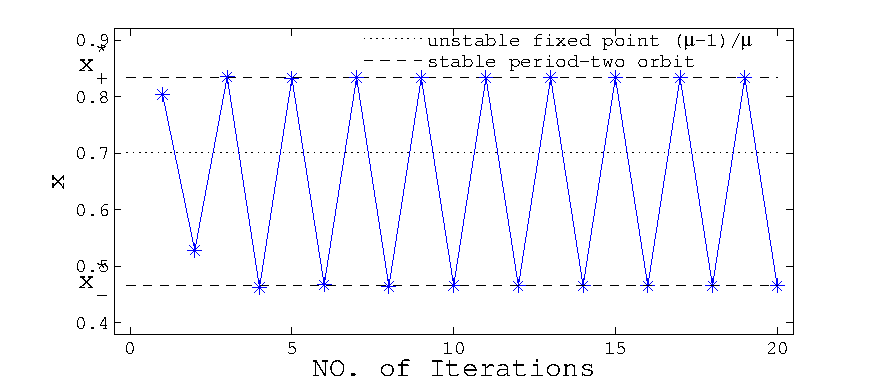
Period-doubling bifurcation: As \(\mu\) passes \(3\), \(f_\mu'\big( (\mu-1)/\mu\big)\) passes \(-1\) and \(x^* = (\mu-1)/\mu\) becomes unstable (see Figure~\ref{fig:p2bi} for sample iterations at \(\mu=3.35\)). A period-two orbit \((x^*_+,x^*_-)\) appears, such that \[ x^*_+ = f_\mu(x^*_-), \quad x^*_- = f_\mu(x^*_+). \] In other words, both \(x^*_+\) and \(x^*_-\) are fixed points of \(x=f_\mu(f_\mu(x))\), but not fixed points of \(x=f_\mu(x)\). This is called period-doubling bifurcation, signified by \(f_{\mu^*}(x^*)=-1\) at \(\mu^*=3\).
Since \[ x - f_\mu\big( f_\mu(x)\big) = x(\mu x-\mu+1)(\mu^2x^2-(\mu^2+\mu)x+\mu+1), \] all fixed points of \(x=f_\mu\big( f_\mu(x)\big)\) are \[ x^*=0, \quad x^* = \frac{\mu-1}{\mu}, \quad x^*_\pm = \frac{\mu+1\pm \sqrt{(\mu-3)(\mu+1)}}{2{\mu}}. \] The first two are inherited from \(x^*=f_\mu(x^*)\), and the last two form the period two orbits, solving the quadratic equation \(\mu^2x^2-(\mu^2+\mu)x+\mu+1=0\). A more involved calculation shows that the this period-two orbit loses its stability, when the modulus \[ \left. \frac{d}{dx} f_\mu\big( f_\mu(x)\big) \right|_{x^*_\pm} =f_\mu'\big(f_\mu(x)\big)f_\mu'(x)\Big|_{x^*_\pm} = f_\mu'(x^*_+)f_\mu'(x^*_-) \] is greater than unit. First from \[ {x^*_+}+{x_-^*} = \frac{\mu+1}{\mu},\quad {x^*_+}{x^*_-} = \frac{\mu+1}{\mu^2}, \] the Jacobian \(\left. \frac{d}{dx} f_\mu\big( f_\mu(x)\big) \right|_{x^*_\pm}\) can be simplified as \[ f_\mu'(x^*_+)f_\mu'(x^*_-) = \mu^2 (1-2{x_-^*})(1-2{x_+^*}) = \mu^2 \big(1 - 2({x_+^*}+{x_-^*}) + 4{x^*_-x^*_+}\big) = 4+2\mu-\mu^2. \] By solving \(\left. \frac{d}{dx} f_\mu\big( f_\mu(x)\big) \right|_{x^*_\pm}=\pm 1\), we get \(\mu = -1\) or \(\mu = 3\) for \(\left. \frac{d}{dx} f_\mu\big( f_\mu(x)\big) \right|_{x^*_\pm}=1\) and \(\mu = 1\pm \sqrt{6}\) for \(\left. \frac{d}{dx} f_\mu\big( f_\mu(x)\big) \right|_{x^*_\pm}=-1\). We do not need to check the negative values of \(\mu=-1\) or \(\mu=1-\sqrt{6}\); in fact the fixed points \(x^*_\pm\) exists only for \(\mu\geq 3\). Therefore, the only possible bifurcation is at \(\mu^*=1+\sqrt{6}\approx 3.449\), with \(\left. \frac{d}{dx} f_{\mu^*}\big( f_{\mu^*}(x)\big) \right|_{x^*_\pm} =-1\). The value \(-1\) suggests another period-doubling bifurcation for \(x=f_\mu(f_\mu(x))\), leading to period-four orbits, which are fixed points of \(x=f_\mu(f_\mu (f_\mu( f_\mu(x))))\).
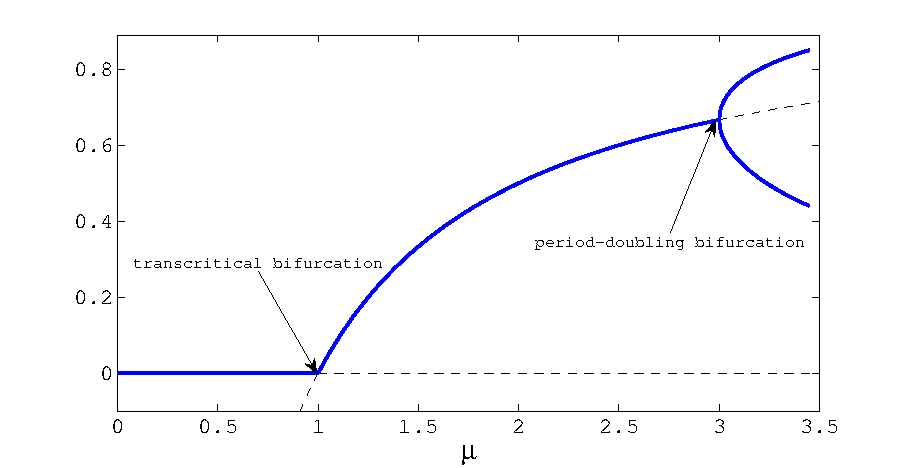
In fact there is an infinite cascade of `period-doubling' bifurcations: \begin{align*} \hskip 1in\mu_1 &= 3 \qquad \qquad && \text{ period } 1 \to 2& \hskip 2in\cr \mu_2 &= 1 + \sqrt{6} \quad \; &&\text{ period } 2 \to 4 &\cr & \vdots & & \cr \mu_n & \qquad \qquad \quad \;\; &&\text{ period } 2^{n-1} \to 2^n.& \end{align*} Moreover, \(\mu_n\) has a finite limit (about \(3.56995\)), when the period-doubling cascade ends and chaotic behaviours start. There is also a universal Feigenbaum constant defined as the limit of ratio between the lengths of two successive bifurcation intervals, i.e, \(\lim_{n\to\infty} \frac{\mu_{n-1} - \mu_n}{\mu - \mu_{n+1}} \approx 4.669 \) Many other maps exhibit similar (period-doubling) bifurcations, and the above limiting ratio is independent of the details of the map.
You can move the slider in a more restricted region of \(\mu\), to understand the onset of periodic doubling bifurcation.