The same approach can be used to study the bifurcation of two-dimensional maps,
by looking at when the change in the parameter leads to eigenvalues of
the Jacobian matrix with unit modulus.
Example 6.2 Consider the map \[ x_{n+1} = \mu y_n +x_n-x_n^2,\qquad
y_{n+1} = x_n, \] where \(|\mu|\) is small. The fixed point \((x^*,y^*)\)
satisfies the equations \(x=\mu x + x - x^2, y=x\). That is, there are
two fixed points \[ (x_1^*,y_1^*) = (0,0),\qquad (x_2^*,y_2^*) = (\mu,\mu).
\] From the Jacobian matrix \[ J(x,y) = \begin{pmatrix} \frac{\partial
}{\partial x} (\mu y+x-x^2) & \frac{\partial }{\partial y} (\mu y+x-x^2)
\cr \frac{\partial }{\partial x} x & \frac{\partial }{\partial y} x \end{pmatrix}
=\begin{pmatrix} 1-2x & \mu \cr 1 & 0 \end{pmatrix}, \] we get \[ J(x_1^*,y_1^*)
= \begin{pmatrix} 1 & \mu \cr 1 & 0 \end{pmatrix},\qquad J(x_2^*,y_2^*)
= \begin{pmatrix} 1-2\mu & \mu \cr 1 & 0 \end{pmatrix}. \] At the fixed
point \((x_1^*,x_2^*)\), the two eigenvalues are governed by \[ \det \big(\lambda
I - J(x_1^*,y_1^*)\big) =\det \begin{pmatrix} \lambda -1 & -\mu \cr -1
& \lambda \end{pmatrix} =\lambda^2 - \lambda - \mu=0. \] That is \[ \lambda_1^\pm
= \frac{1\pm \sqrt{1+4\mu}}{2}. \] As \(\mu\) passes zero, \(\lambda_1^+\)
pass 1 and this fixed point \((x_1^*,y_1^*)\) becomes unstable. At the
fixed point \((x_2^*,y_2^*)\), the two eigenvalues are governed by \[ \det
\big(\lambda I - J(x_2^*,y_2^*)\big) =\det \begin{pmatrix} \lambda -1+2\mu
& -\mu \cr -1 & \lambda \end{pmatrix} =\lambda^2 - (1-2\mu)\lambda - \mu=0.
\] That is, \[ \lambda_2^\pm = \frac{1-2\mu\pm \sqrt{(1-2\mu)^2+4\mu}}{2}
=\frac{1-2\mu\pm \sqrt{1+4\mu^2}}{2}. \] In this case, \(\lambda_2^-\)
is close to zero (\(|\lambda_2^+|\) is far away from unit) and can not
trigger any instability. If \(\mu\) is small and negative, \[ \sqrt{1+4\mu^2}
>\sqrt{1+4\mu+4\mu^2}=1+2\mu \] and \[ \lambda_2^+ = \frac{1-2\mu+\sqrt{1+4\mu^2}}{2}
> \frac{1-2\mu+(1+2\mu)}{2} = 1. \] As a result, the fixed point \((x_2^*,y_2^*)\)
is unstable. On the other hand, if \(\mu\) becomes positive (and small),
\( \sqrt{1+4\mu^2}
< \sqrt{1+4\mu+4\mu^2}=1 +2\mu \) and \[ \lambda_2^+=
\frac{1-2\mu+\sqrt{1+4\mu^2}}{2}
< \frac{1-2\mu+(1+2\mu)}{2}=1 . \] Therefore, the stability of the two
fixed points \((x_1^*,y_1^*)\) and \((x_2^*,y_2^*)\) are exchanged, indicating
the transcritical bifurcation at \(\mu=0\).
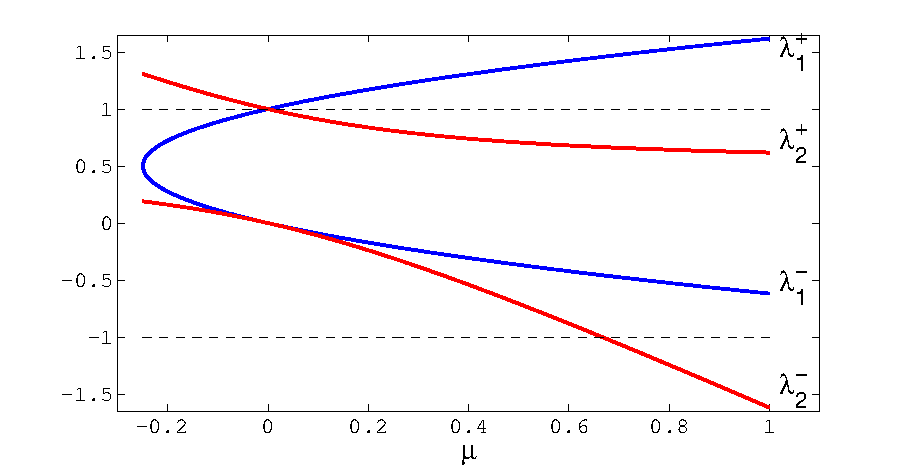
Figure 6.8: The eigenvalues of the Jacobian matrix near the two fixed points \((0,0)\)
and \((\mu,\mu)\).
The bifurcation is also clear from Figure 6.8. For \(\mu \in (-1/4,0)\), \(|\lambda_1^\pm|
<1\) and the fixed point \((x_1^*,y_1^*)=(0,0)\) is stable. The other fixed point
\((x_2^*,y_2^*)=(\mu,\mu)\) is stable for \(\mu>0\), but becomes unstable again when \(\lambda_2^-=-1\), or \(\mu=2/3\).
A period-doubling bifurcation occurs her (associated with eigenvalue
\(-1\)).
You can understand the transcritical bifurcation in the previous example using the simulation below. Choose different values of \( \mu \), and then click
on the plane for the initial condition (subsequent points are plotted with an expanding circle.