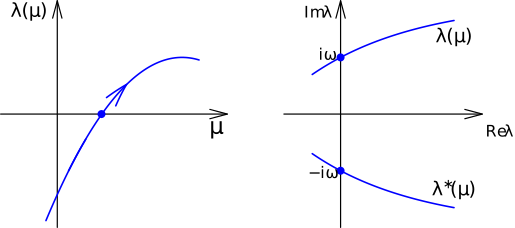
For the general ODE \(\dot{x} =f(x)\) near its stationary point \(x^*\), we learned early that if none of the eigenvalues of the Jacobian \(Df(x^*)\) has a real part zero, then the behaviour of \(\dot{x}=f(x)\) is determined by its linearised system \(\dot{y} = Df(x^*)y\) with \(y\approx x-x^*\). What happens if the Jacobian matrix \(Df(x^*)\) has eigenvalues with zero real part?
If some eigenvalues have zero real part, nonlinear terms are expected to play a role, and the behaviour could change accordingly. The study of these qualitative changes in the behaviours (mainly stability/instability of stationary points and periodic orbits), subject to changes in certain parameters, is call \emph{bifurcation theory}. Since the stability/instability of fixed points is indicated precisely by the real part of the eigenvalues, we are going to see how these eigenvalues pass the imaginary axis, as the parameter changes.
We learned Stable Manifold Theorem earlier, which states that the structure of the system near a hyperbolic fixed point does not change when nonlinear terms are added. Consider the system \[ \dot{x}=-x,\quad \dot{y} = y+x^2\] and its linearised system as shown in Figure 5.2.
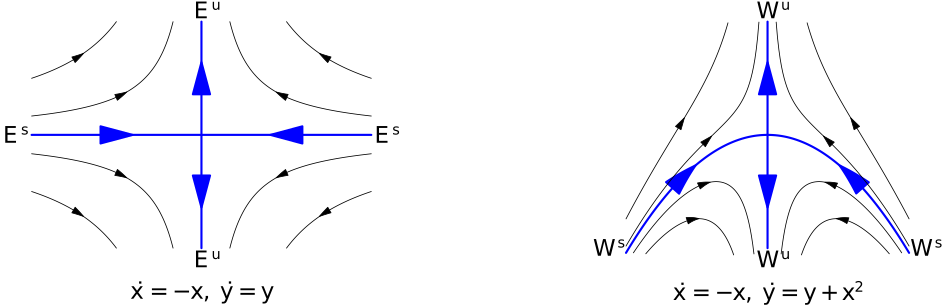
The stable manifold \(E^s\) and the unstable manifold \(E^u\) for the linearised system (in normal form) are easy to calculate, which is just the horizontal and vertical axis. Therefore, the notation \(E^s\) and \(E^u\) (instead of \(E^s\) and \(E^u\)) is used for the linearised system, to emphasize that they are linear vector spaces. The corresponding stable and unstable manifold for the nonlinear system are usually curved. For the system \(\dot{x}=-x, \dot{y}=y+x^2\), the unstable manifold is still the vertical axis (show this!), but the stable manifold is different, and can be approximated as a local series expansion \begin{equation}\label{eq:myws} W^s = \big\{ (x,y) \mid y = M(x) = a_2x^2+a_3x^3+\cdots\big\}. \end{equation} The constant term in \(M(x)\) vanishes because \(W^s\) passes the origin, and the linear term vanishes because \(W^s\) should be tangent to \(E^s\) (the horozontal axis), the stable manifold of the linearised system. Now the coefficients \(a_2,a_3,\cdots\) representing \(W^s\) can be obtained by taking the derivative of both sides of \(y=M(x)\). On one hand \[ \dot{y} = y+x^2 = (a_2+1)x^2+a_3x^3+\cdots. \] On the other hand, \[ \frac{d}{dt} M(x) = \left( 2a_2x+3a_3x^2+\cdots\right)\dot{x} = (-x) \left( 2a_2x+3a_3x^2+\cdots\right). \] Matching the two expressions for \(\dot{y}=\frac{d}{dt}M({x})\), we get \(a_2=-1/3,a_3=a_4=\cdots=0\). In other words, the stable manifold is exactly \(y=-x^2/3\).
Because the real parts of the eigenvalues are away from zero, the nonlinear system is stable under changes in the parameters or nonlinear terms. However, if there is any eigenvalue with zero real part, we expect some qualitative changes in the property when certain parameter changes, which precisely why bifurcation theory and Centre Manifold Theorem are studied together.
Theorem 5.1 ( Centre Manifold Theorem) Given \( \dot{x}=f(x), x \in \mathbb{R}^n\), \(f\) smooth and suppose \(x=0\) is a stationary point. Suppose the Jacobian matrix \(Df(0)\) has eigenvalues in sets \(\sigma_u\) with \(\Re (\lambda ) >0\), \(\sigma_s\) with \(\Re (\lambda )<0\) and \(\sigma_c\) with \(\Re(\lambda)=0\) and corresponding generalized linear eigenspaces \(E^u\), \(E^s\) and \(E^c\) respectively. Then there exist unstable and stable manifolds \(W^u, W^s\) of the same dimension as \(E^u, E^s\) and tangential to \(E^s\) and \(E^u\) at \(x=0\); and an invariant centre manifold \(W^c\) tangential to \(E^c\) at \(x=0\). \vspace{5pt} So in general, locally \(\mathbb{R}^n = W^c \oplus W^u \oplus W^s \) with the approximate governing equations on each manifold \begin{align*} \dot{x} &= g(x) \qquad \text{ on } W^c \\ \dot{y} &= By \qquad \text{ on } W^s \qquad \text{ (stable directions)} \\ \dot{z} &= Cz \qquad \text{ on } W^u \qquad \text{ (unstable directions) }, \end{align*} where \(g(x)\) is quadratic (or higher order) in \(x\), all eigenvalues of \(B\) have negative real parts, and all eigenvalues of \(C\) have positive real parts.
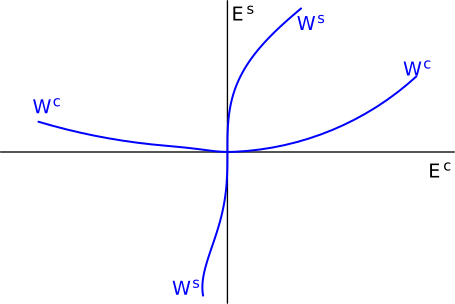
In Figure 5.3, there is no unstable direction and in the stable direction the dynamics is attracting, so solutions tend to the centre manifold very quickly. The dynamics on \(W^c\) depends on nonlinear terms, is usually much slower and characterise the dynamics of the whole system in the long time. So the question is how this decomposition can be useful in general, and how the centre manifold can be approximated or computed.