2.2 Trajectories, phase portrait and flow on the phase space
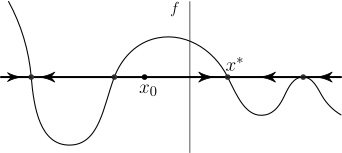
In many situations, although explicit solutions of the underlying equations may not be available, qualitative properties and long time behaviours can still be obtained using various techniques. For example, we can understand solutions of the logistic ODE \[ \dot{x} = x(1-x) \] with different initial conditions \(x(0)\). If \(x(0)<0\), then \(x(t)\) decreases, and \(x(t) \to -\infty\) as \(t \to \infty\). If \(x(0) \in (0,1)\), then \(x(t)\) increases to \(1\) and finally if \(x(0) >1\), \(x(t)\) decreases to \(1\). In general, for the one dimension equation \(\dot{x} = f(x)\), although we can get the solution from \[ \int_{x(0)}^{x(t)} \frac{\mathrm{d} x}{f(x)} = t, \] the qualitative properties can be understood better using a phase portrait as Figure 2.1: \(x\) increases on regions where \(f(x)>0\) and decreases where \(f(x)<0\).
Figure 2.1: Phase portrait of the one dimensional autonomous equation \(\dot{x}=f(x)\).
This picture can be extended to higher dimensions. Consider
the equation \(\dot{x}=f(x)\) with \(x\in\mathbb{R}^n\) and
\(f:\mathbb{R}^n\mapsto\mathbb{R}^n\). If we plot the trajectory
\(\{ x(t)\mid t_1\leq t\leq t_2\}\) in \(\mathbb{R}^n\) for some
time \(t_1\) and \(t_2\), then \(f(x(t))\) is exactly the tangent
vector of \(x(t)\) (the definition of the ODE \(\dot{x}=f(x)\)!).
In other words, once we have the vector field \(f(x)\)
at any points \(x\), then we can ``integrate'' along the vector
field to get the solution trajectory, as in
Figure 2.1. A sketch of the different trajectories
in phase space is called a phase portrait. Indicate the
direction of time on phase portraits by an arrow denoting the
direction of increasing time along the trajectory. In some cases,
some trajectories can be obtained explicitly by solving ODEs with
time \(t\) eliminated; otherwise, general behaviour of the
underlying system can be inferred by "connecting" the vector
field given by \(f(x)\).
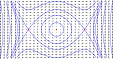
Figure 2.2: Vector fields and phase portrait for the system \(\dot{x}=y,\dot{y}=-x+x^3\).
Example 2.6 (Equations governed by trajectories) Consider the system \[ \dot{x} = -y,\quad \dot{y} = x. \] The trajectory is governed by the different equation \[ \frac{\mathrm{d} y}{\mathrm{d} x} = \frac{\dot{y}}{\dot{x}} = -\frac{x}{y}, \] which is separable. Rewriting this ODE as \(y\mathrm{d} y+x\mathrm{d} x=0\) and integrating both sides, we get \[ x^2+y^2 = C \] for some constant \(C>0\).
Example 2.7 (Newtonian dynamics in one dimension) Consider the Newtonian dynamics \(m\mathrm{d}ot{x} = -U'(x)\) in one dimension (so \(x\) is a scalar, \(m\) is the mass and \(U\) is called the potential). By introducing the momentum \(p = m\dot{x}\), then the original second order scalar ODE is equivalent to the first order system \[ \dot{x} = \frac{p}{m},\quad \dot{p} = -U'(x). \] The trajectory, governed by the ODE \(\frac{\mathrm{d} p}{\mathrm{d} x} = -\frac{mU'(x)}{p}\) is separable, is \[ \frac{p^2}{2m} + U(x) = E \] for some constant \(E\), called the total energy.
Example 2.8 For the ODE \(\dot{x}=y,\dot{y}=-x+x^3\), the ODE governing the trajectory is \[ \frac{\mathrm{d} y}{\mathrm{d} x} = \frac{-x+x^3}{y}. \] Therefore the trajectories are \(x^2+y^2-x^4/2=C\) for some constant \(C\) (not necessarily positive).
Click your mouse on different locations of the plane, to understand
the following geometric concepts, in the context of the previous ODE \(\dot{x}=y,
\dot{y}=-x+x^3\):
Remark For two dimensional system
\(\dot{x}=f(x,y), \dot{y}=g(x,y)\), the differential equation
\(\frac{\mathrm{d} y}{\mathrm{d} x} = \frac{g(x,y)}{f(x,y)}\)
can not always be solved explicitly. For instance, if the
system in the previous example is changed to
\(\dot{x}=y+x,\dot{y}=-x+x^3\), there seems no expressions for
general trajectories. But whenever there is a solution that
written in the form \(F(x,y) = C\), the function \(F(x,y)\) is
called a conserved quantity (because the time
derivative \(\frac{d}{dt}F(x,y)\) is zero), containing
important information about the underlying system.
In most cases, it is easier to write the
trajectories implicitly as \(x^2+y^2=C\) or
\(x^2+y^2-x^4/2=C\) in previous two examples. There is no need
to write \(y\) as a function of \(x\) or \(x\) as a function of
\(y\).
Semi-group property for autonomous ODEs
Another way of representing solutions is via the flow: \(x(t) = \varphi_t (x_0)\) represents the solution to \(\dot{x}=f(x)\) at time \(t\) with initial condition \(x_0\) at \(t=0\), i.e. \(\varphi_0 (x_0)=x_0\) and \[ \frac{\mathrm{d} }{\mathrm{d} t} \varphi_{t}(x_0) = f(\varphi_t(x_0)). \] For example, the solution to the system of ODEs \[ \dot{x} = -x + y,\quad \dot{y} = -y \] with initial condition \((x_0,y_0)\) is given by \[ \varphi_t(x_0,y_0) = (x_0e^{-t}+te^{-t}y_0,e^{-t}y_0). \]
For autonomous equations \(\dot{x}=f(x)\), where \(f\) has no explicit dependence on \(t\), the solution \(\varphi_t(x)\) satisfies the semi-group property, \begin{align*} \varphi_{t+s}(x) & = \varphi_t( \varphi_s(x)) = \varphi_s(\varphi_t(x)). \end{align*} This fact can be verified by the uniqueness of the solution to the system \(\dot{x}=f(x)\), by defining two functions \(\psi_1(t) = \varphi_{t+s}(x), \psi_2(t)=\varphi_t(\varphi_s(x))\). Then \(\psi_1(t)\) is a solution to \(\dot{x}=f(x)\) with initial condition \(\psi_1(0)= \varphi_s(x)\) and \(\psi_2(t)\) is also a solution to \(\dot{x}=f(x)\) with initial condition \(\psi_2(0) = \varphi_0(\varphi_s(x))=\varphi_s(x)\). Since \(\psi_1(0)=\psi_2(0)\), by the uniqueness of solutions to ODEs, \(\psi_1(t)=\psi_2(t)\), or \( \varphi_{t+s}(x) = \varphi_t(\varphi_s(x))\). Similarly, we can show \( \varphi_{t+s}(x) = \varphi_s( \varphi_t(x))\).
Example 2.9 The solution to the ODE \(\dot{x} = x^2, x(0)=x_0\) satisfies the semi-group property. In fact, this is an separable ODE. Integrating both sides of \(x^{-2}\mathrm{d} x = dt\), we get \[ t = \int_0^t \mathrm{d} t = \int_{x_0}^{x(t)} \frac{\mathrm{d} x}{x^2} = \frac{1}{x_0} - \frac{1}{x(t)}. \] That is \(\varphi_t(x_0)=\frac{x_0}{1-tx_0}\) and \(\varphi_s(\varphi_t(x_0)) = \varphi_s\left( \frac{x_0}{1-tx_0}\right) = \frac{ {\frac{x_0}{1-tx_0}}} {1-s{\frac{x_0}{1-tx_0}}} = \frac{x_0}{1-(t+s)x_0} =\varphi_{t+s}(x_0). \)
Remark The reason we use semi-group instead of group here is that some dynamical systems can not be defined backward in time, or lose the uniqueness of solution when solving backward in time (common for infinite dimensional systems, like partial differential equations).
Remark The solution of any autonomous system always satisfies the semi-group property (the law of dynamics does not dependent on
"time"); on the other hand, if a function \(\varphi_t(x_0)\) satisfies the semi-group property, then it is the solution to the first order autonomous system
\(\dot{x} = f(x), x(0)=x_0\). The function \(f\), or the "law of dynamics" can be actually determined by writing \(\frac{d}{dt}\varphi_t(x_0)\) as a
function \(f(\varphi_t(x_0))\). For instant, if \(\varphi_t(x_0) = x_0/(1-tx_0)\), then \(\frac{d}{dt} \varphi_t(x_0) = x_0^2/(1-tx_0)^2=
(\varphi_t(x_0))^2=f(\varphi_t(x_0))\) with \(f(x)=x^2\), the same as in Example 2.9 (there is no explicit \(t\) dependence). Alternatively, \(f(x)\) can be determined at the initial time (the law can be inferred from any instance of time). That is, \(\left. f(x) = \frac{\mathrm{d}}{\mathrm{d} t} \varphi_t(x)\right|_{t=0}\).