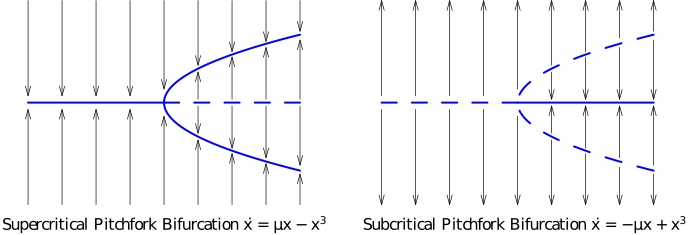
Suppose \(x=0 \in \mathbb{R}^n\) is a stationary point of the system of ODEs \(\dot{x}=f(x,\mu)\) if \(\mu=0\), and \(D_xf(0,0)\) has a single zero eigenvalue. (If the stationary point is \(x^*\) at \(\mu^*\), then we simply work in shifted coordinates \(x-x^*\) and \(\mu -\mu^*\)). Now we consider the extended centre manifold for the system governed by (\(x\in\mathbb{R}\)) \[ \dot{x} = f(x,\mu),\qquad \dot{\mu}=0 \] where \(f\) satisfies \(f(0,0)=0\) and \(f_x(0,0)=0\). Consider the Taylor series expansion of \(f\) for \(|x|, |\mu|\) small: \[\dot{x} = f(0,0) + f_x(0,0) x + f_\mu(0,0) \mu + \frac{1}{2!} (f_{xx} x^2 + f_{\mu \mu} \mu^2 + 2 f_{x \mu} x \mu ) + O(|x|^3,|\mu|^3)\] where all partial derivatives are evaluated at \((0,0)\).
By the assumption that \(f(0,0)=0\) (\(x=0\) is the stationary point on the centre manifold for \(\mu=0\)) and \(f_x(0,0)=0\) (there is a zero eigenvalue), the above Taylor series is simply \[\dot{x} = f_\mu(0,0) \mu + \frac{1}{2} \left(f_{xx}(0,0) x^2 + f_{\mu \mu}(0,0) \mu^2 + 2 f_{x \mu}(0,0) x \mu \right) + \cdots. \] Different bifurcations could occur, depending on whether the partial derivatives vanish or not.
If both \(f_\mu(0,0)\) and \(f_{xx}(0,0)\) are non-zero, then \[ \dot{x} = f_\mu(0,0) \mu + \frac{1}{2} f_{xx}(0,0) x^2+ O(|x\mu|,|\mu|^2,\cdots) \approx \mu f_\mu(0,0) + \frac{x^2}{2}f_{xx}(0,0). \] The stationary points are \begin{equation}\label{snquad} x_\pm^* \approx \pm \sqrt{-\frac{2 f_\mu(0,0)}{f_{xx}(0,0)}\mu} \end{equation} if \(\mu f_\mu(0,0)/f_{xx}(0,0)\leq 0\). So the stability is determined for sufficiently small \(|x|\) and \(|\mu|\) by the sign of \(f_{xx}\) and \(f_\mu\): there is no solution, if \(\mu f_\mu/f_{xx}> 0\), and there are two solutions given by~\eqref{snquad} if \(\mu f_\mu/f_{xx}\leq 0\). Since \[ \left. \frac{\partial }{\partial x} f(x,\mu)\right|_{x=x_\pm^*} \approx x_\pm^*f_{xx}(0,0) = \pm \sqrt{-\frac{2 f_\mu(0,0)}{f_{xx}(0,0)}\mu}f_{xx}(0,0). \] Therefore, if \(\mu f_\mu/f_{xx}> 0\), \(x_+\) is stable, \(x_-\) unstable if \(f_{xx} <0\) and \(x_-\) is stable, \(x_+\) unstable if \(f_{xx} >0\) This is a \emph{saddle-node} bifurcation, also called tangential bifurcation or fold bifurcation.
If in addition to \(f(0,0)=f_x(0,0)=0\), \(f_\mu(0,0)\) is zero, but \(f_{xx}(0,0)\neq0\), the ODE equation becomes \[ \dot{x} \approx \frac{1}{2} \Big(f_{xx}(0,0)x^2 + 2 f_{x \mu}(0,0) x \mu + f_{\mu \mu}(0,0) \mu^2\Big) \] Then the possible stationary points are \(x_\pm^* = k_\pm \mu\), where \[ k_\pm = \frac{- f_{x \mu} \pm \sqrt{ f_{x \mu}^2 - f_{xx} f_{\mu \mu} }}{ f_{xx}}. \] So if \(f_{x \mu}^2 - f_{xx}f_{\mu \mu}>0\), there are two branches of solutions which intersect at the bifurcation point \((0,0)\). This is a \emph{transcritical} bifurcation. Stability is determined by looking at the leading order terms of the derivative \(f_x(x, \mu )\) and a relatively simple manipulation shows that one branch is stable and the other is unstable, with stability being \emph{exchanged} as \(\mu\) passes through zero. To show the stability, \[ \left. \frac{\partial}{\partial x} f(x,\mu)\right|_{x=x_\pm^*}= f_{xx}(0,0)x_\pm^*+f_{x\mu}(0,0)\mu = \pm \mu \sqrt{ f_{x \mu}^2 - f_{xx} f_{\mu \mu} }. \] So the fixed point \(x_+\) is stable if \(\mu<0\) and unstable if \(\mu >0\); \(x_-\) has the opposite stability property.
If \(f_\mu(0,0)=f_{xx}(0,0)=0\) then \begin{equation}\label{pfeq} \dot{x} \approx \frac{1}{2} \big(f_{\mu \mu} \mu^2 + 2 f_{x \mu} x \mu \big) + \frac{1}{6} \big(f_{xxx} x^3 + f_{\mu \mu \mu} \mu^3 + \dots\big). \end{equation} If \(f_{x\mu}\neq 0\), there is one branch of solutions with \(x\approx -\frac{f_{\mu\mu}}{2f_{x\mu}}\mu\). However there is a second set of solutions by balancing the second term \(f_{x\mu}x\mu\) and the third terms \(f_{xxx}x^3\): \[ f_{x \mu} x \mu + \frac{1}{6} f_{xxx} x^3=0 \] from which, provided \(f_{xxx}\ne 0\), \begin{equation}\label{pfbif} x^2=-\frac{6f_{x\mu}}{f_{xxx}}\mu \end{equation} giving two new solutions in whichever sign of \(\mu\) makes the right hand side positive. There are no other ways of balancing leading order terms (by posing \(x\sim \mu^\alpha\)) so these are the only bifurcating solutions. Since \begin{equation}\label{pfst} \frac{\partial}{\partial x} f (x,\mu)=f_{x\mu}\mu+\frac{1}{2}f_{xxx}x^2+\cdots, \end{equation} we see that the solution \(x\approx -\frac{f_{\mu\mu}}{2f_{x\mu}}\mu\) is stable (locally) if \(f_{x\mu}\mu<0\) and unstable if \(f_{x\mu}\mu>0\). So the sign of \(f_{x\mu}\) determines on which side of \(\mu=0\) this branch is stable.
The stability of second set of solutions is determined by substituting (\ref{pfbif}) into (\ref{pfst}) giving \(-2f_{x\mu}\mu\) and so the stability is the opposite of the simple branch described above.
This is called a \emph{pitchfork} bifurcation: if the non-trivial branch is stable
it is called a \emph{supercritical} pitchfork bifurcation and if the non-trivial
branch is unstable it is called a \emph{subcritical} pitchfork bifurcation, as
shown in Figure 5.8.