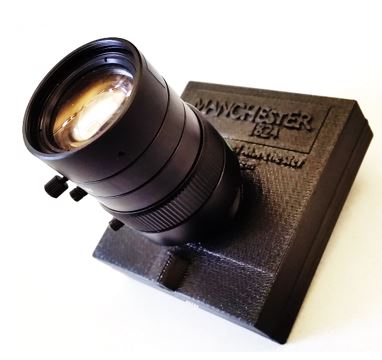
 SCAMP-5
is the latest in the family of our pixel-per processor vision chips
using analogue processing elements. The chip can execute many image
processing algorithms in real-time with minimal power consumption. The
smart camera systems based on the chip are currently used in a number
of projects in our lab and in the labs of our collaborators in the UK
and overseas. The sensor/processor integration and massively parallel
operation provide a low-cost, low-power, high-performance intelligent
vision systems for robotics, surveillance, machine vision, biomedical
applications and research on algorithms for cellular processor arrays.
Please see the SCAMP Vision
Sensor webpage for more information.
SCAMP-5
is the latest in the family of our pixel-per processor vision chips
using analogue processing elements. The chip can execute many image
processing algorithms in real-time with minimal power consumption. The
smart camera systems based on the chip are currently used in a number
of projects in our lab and in the labs of our collaborators in the UK
and overseas. The sensor/processor integration and massively parallel
operation provide a low-cost, low-power, high-performance intelligent
vision systems for robotics, surveillance, machine vision, biomedical
applications and research on algorithms for cellular processor arrays.
Please see the SCAMP Vision
Sensor webpage for more information.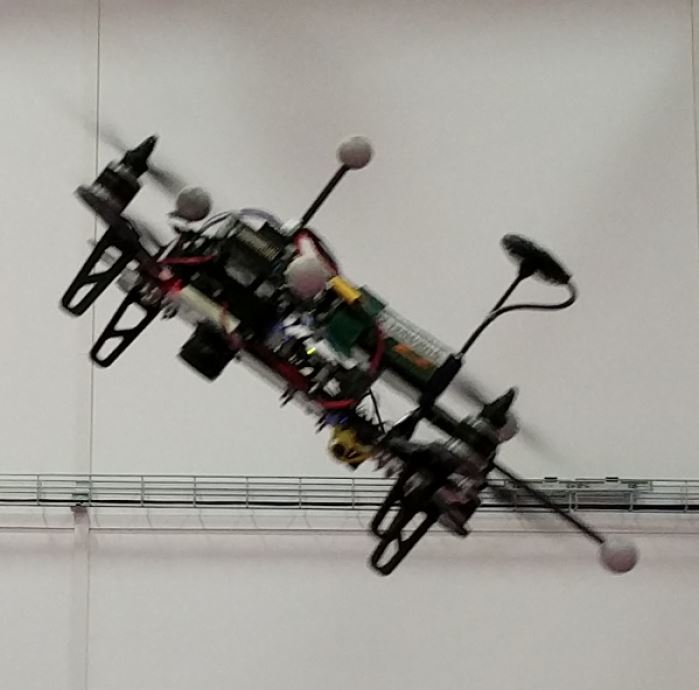 AVIATE (An Integrated Vision and Control Architecture
for Agile Robotic Exploration), also known as "Project AGILE" is an
EPSRC funded project, in
collaboration
with The University of Bristol. We investigate the application of pixel
processor array vision sensors to the problem of controlling an
autonomous Micro Air Vehicle (drone). We are interested in exploting
the high-speed capabilities of the sensor/processor approach to support
agile manouvering and navigation. See
project
web page for more information, including videos of our system
in action.
AVIATE (An Integrated Vision and Control Architecture
for Agile Robotic Exploration), also known as "Project AGILE" is an
EPSRC funded project, in
collaboration
with The University of Bristol. We investigate the application of pixel
processor array vision sensors to the problem of controlling an
autonomous Micro Air Vehicle (drone). We are interested in exploting
the high-speed capabilities of the sensor/processor approach to support
agile manouvering and navigation. See
project
web page for more information, including videos of our system
in action.
PlastiARMPit is a InnovateUK project, in collaboration with School of Chemistry, ARM, Unilever and PragmatIC, developing a high-performance energy-efficient processing engine to deliver future flexible electronic devices. We aim to build a fully flexible proof-of-concept prototype of e-nose sensors, interface and Neural Network Processing Engine (NNPE), using plastic electronics technology.

FORTE (Functional Oxide Reconfigurabe Technologies) is an EPSRC Programme Grant, in collaboration with The University of Southampton and Imperial College, London. The purpose of the project is to investigate reconfigurable circuits and systems built using novel nanoelectronic components, known as ReRAM or "memristor" devices. In this project we are developing the fabrication technologies enabling integration of CMOS devices with memristive devices, design infrastrucure, including EDA tools, to enable design with these devices, and circuit and system architectures that exploit the properties of these devices to achieve new functionalities. Our lab focusses on using these devices in analogue reconfigurable circuits, novel computing architectures, and neuromorphic systems.
 pNeuron
(Printed Electronics for Neuromorphic Computing). In
this project, funded by the EPSRC Centre for
Inoovative Manufacturing in Large-Area Electronics, under the
Pathfinder scheme,
we investigated the implementation of spiking neuron circuits,
mimicking biological behaviour, using printed electronics technology.
Furter details about the project can be found
pNeuron
(Printed Electronics for Neuromorphic Computing). In
this project, funded by the EPSRC Centre for
Inoovative Manufacturing in Large-Area Electronics, under the
Pathfinder scheme,
we investigated the implementation of spiking neuron circuits,
mimicking biological behaviour, using printed electronics technology.
Furter details about the project can be found 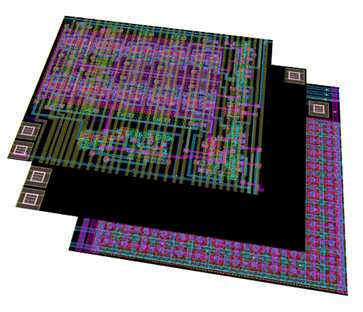 FINE3D
(Fine-Grain Processor Arrays in 3D Silicon Technologies). In this
project, funded by the EPSRC, we investigated the design of
cellular processor arrays for next-generation silicon technologies,
where many device layers can be integrated in a single device. Wafer
stacking and massive interconnect achieved using through-silicon-vias
provides both opportunities and design challenges. We researched
processor architectures that make best use of the available intra-layer
bandwidth, investigated partitioning of the processing circuitry
amongst silicon layers, and looked into heterogenous architectures
where different layers are fabricated using different technologies,
most suitable for individual system components. In particular, we are
interested in fine-grain processor arrays, which we believe provide
architectural solution that can fully exploit the benefits offered by
the 3D integration.
FINE3D
(Fine-Grain Processor Arrays in 3D Silicon Technologies). In this
project, funded by the EPSRC, we investigated the design of
cellular processor arrays for next-generation silicon technologies,
where many device layers can be integrated in a single device. Wafer
stacking and massive interconnect achieved using through-silicon-vias
provides both opportunities and design challenges. We researched
processor architectures that make best use of the available intra-layer
bandwidth, investigated partitioning of the processing circuitry
amongst silicon layers, and looked into heterogenous architectures
where different layers are fabricated using different technologies,
most suitable for individual system components. In particular, we are
interested in fine-grain processor arrays, which we believe provide
architectural solution that can fully exploit the benefits offered by
the 3D integration.
 REVERB
(Reverse Engineering
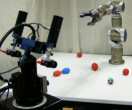
the Vertebrate Brain). This
project was a multidisciplinary collaboration between a number of
universities (Manchester, Sheffield, Aberystwyth, Bristol, Dundee)
investigating integrative computation for autonomous agents, based on
action-selection architecture of the basal ganglia. We were
implementing low-level image processing required for this project, as
well as some neural models, using SCAMP-3 and SCAMP-4 chips. We were
also working towards an FPGA-based accelerator for neural computation,
to tackle the real-time embedded implementation on an autonomous robot.
We developed the
REVERB
(Reverse Engineering
the Vertebrate Brain). This
project was a multidisciplinary collaboration between a number of
universities (Manchester, Sheffield, Aberystwyth, Bristol, Dundee)
investigating integrative computation for autonomous agents, based on
action-selection architecture of the basal ganglia. We were
implementing low-level image processing required for this project, as
well as some neural models, using SCAMP-3 and SCAMP-4 chips. We were
also working towards an FPGA-based accelerator for neural computation,
to tackle the real-time embedded implementation on an autonomous robot.
We developed the  COLAMN
(Computing Architecture Based on Laminar Microcircuitry of the
Neocortex).
This project was a collaboration between neurobiologists, computational
neuroscientists and VLSI engineers (Manchester, Plymouth, Cambridge,
Oxford) aiming at understanding the way cortical circuits process
information, and ultimately providing ideas for building brain-inspired
microelectronic circuits. We have developed an analogue silicon neuron,
which efficiently implements biologically plausible spiking behaviour
of cortical neurons. Currently we are investigating higher-level
cognitive models of the cortex, and their VLSI implementation.
COLAMN
(Computing Architecture Based on Laminar Microcircuitry of the
Neocortex).
This project was a collaboration between neurobiologists, computational
neuroscientists and VLSI engineers (Manchester, Plymouth, Cambridge,
Oxford) aiming at understanding the way cortical circuits process
information, and ultimately providing ideas for building brain-inspired
microelectronic circuits. We have developed an analogue silicon neuron,
which efficiently implements biologically plausible spiking behaviour
of cortical neurons. Currently we are investigating higher-level
cognitive models of the cortex, and their VLSI implementation. 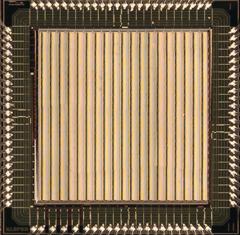 Cellular Asynchronous Arrays.
This project investigates design of vision chips and
fine-grain
processor arrays based on novel control schemes, where individual
processors are triggered as data is available at their neighbours,
optimising speed and power consumption of the devices. The aim is to
provide image processing engines suitable for both low-level,
pixel-based operations (filtering, feature detection etc.) as well as
more global, object-based algorithms, such as object reconstruction,
skeletonisation, watarshed transform, distance transform etc. The ASPA
chip contains a SIMD processor array, operating in mixed
bit-serial/bit-parallel mode, as well as a wave-propagating network.
The work continues on next generation of the ASPA processor in the
Fine-Grain 3D project.
Cellular Asynchronous Arrays.
This project investigates design of vision chips and
fine-grain
processor arrays based on novel control schemes, where individual
processors are triggered as data is available at their neighbours,
optimising speed and power consumption of the devices. The aim is to
provide image processing engines suitable for both low-level,
pixel-based operations (filtering, feature detection etc.) as well as
more global, object-based algorithms, such as object reconstruction,
skeletonisation, watarshed transform, distance transform etc. The ASPA
chip contains a SIMD processor array, operating in mixed
bit-serial/bit-parallel mode, as well as a wave-propagating network.
The work continues on next generation of the ASPA processor in the
Fine-Grain 3D project. 