 |
Warwicker Group
|
  |
|
Bioinformatics,
Biotechnology, Cell Biology
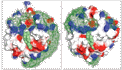
We study structure and function in proteins and other biological molecules, and developed the Finite Difference Poisson-Boltzmann method for computing solvation effects, which has led on to algorithms for calculating and predicting charge-charge interactions and pH-dependent properties. These remain a focus of our research, and allow for specific hypothesis formation and testing with individual molecules. By contrast to studies with individual systems, the post-genomic era, with vast databases of sequences and structures, gives an opportunity to look for partitioning of biophysical properties by sub-group. For example, studying features that separate more from less soluble molecules, and that distinguish proteins from different sub-cellular organelles. In some cases, it is possible to turn the observation around, making predictive tools, or at least uncovering the molecular mechanisms that will lead to predictive tools. Current interests include: Developing models for prediction of redox potential; Enyme active sites, electric fields and activity; Structural correlates of conductance in Ion channels; pH-dependence - models and functional significance; Structured and non-structured aspects of post-translational modification; Structure-function models for cell biology. Substantial effort, funds and collaborative work is directed at Improved algorithms for predicting protein solubility (and their application in a pharmaceutical context). Our group meetings in the Manchester Institute of Biotechnology (MIB) focus on these collaborations. 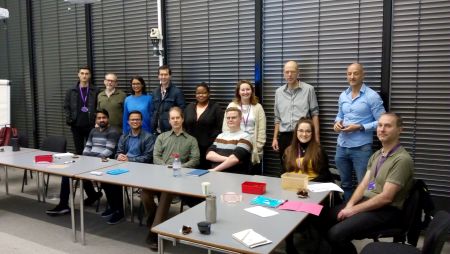  |
||