codespace logo


Martin Dodge (Geography, School of Environment and Development, The University of Manchester) 
Email: m.dodge (at) manchester.ac.uk


Rob Kitchin (National Institute of Regional and Spatial Analysis, National University of Ireland, Maynooth)
Email: rob.kitchin (at) nuim.ie


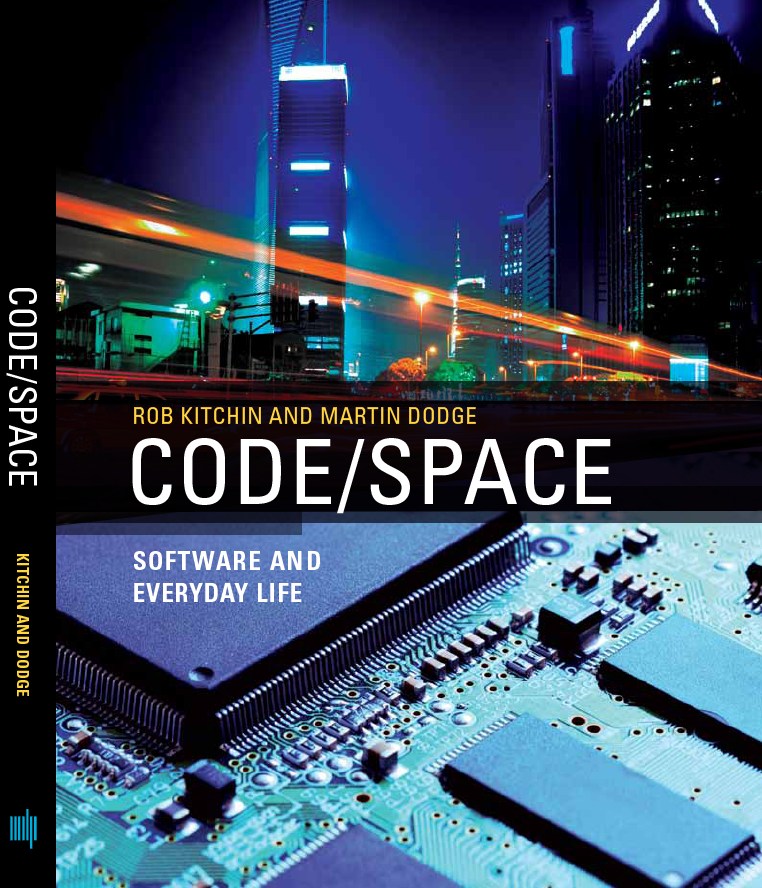
Our ongoing Code/Space research  is seeking to develop new conceptual tools for understanding the relationship between software, technology, space and everyday activities.


Background:
Over the past thirty years, the practices of everyday life have become increasingly infused with and mediated by software. Whatever the task - domestic living, working, consuming, travelling or communicating – software increasingly makes a difference to how social and economic life takes place.  Software is embedded into objects and systems as a means to enhance and manage usage and is pivotal in linking together geographically disparate and distributed infrastructures.  It also enables new and refined processes through the generation, storage, profiling, screening and communication of data about individuals, objects, and transactions.  Importantly, software has profound spatial effects, both through the automatic production of space that generates new spatialities, and the creation of software-sorted or machine readable geographies that alter the nature of access and governmentality.  Software, however, does not simply discipline, it also empowers, bringing into being spaces and social activities that qualitatively enhance daily life for many people.  These processes of regulation and empowerment are sometimes hard to discern as they are often hidden or operate from spaces several steps removed from the places of embodied experience.  Nonetheless, given their increasingly widespread deployment, it is essential to tease them out and think them through.


Code/Space research is examining the new spatialities and new modes of (spatial) governance and empowerment enabled by the development and adoption of software through an exploration of the dyadic relationship between software and space; how the production of space is increasingly reliant on code, and code is written to produce space.  In so doing, we are developing a set of conceptual tools for identifying and understanding these relationships, illustrating our arguments through rich, contemporary empirical material relating to different spatial spheres and everyday activities (travel, home, work, consumption).  The principal concepts we detail are transduction and automated management.  Through the concept of transduction we theorise space and spatialities as ontogenetic in nature, as constantly in a state of becoming.  Software, through its technicity – its ability to do work in the world - transduces space; enables space to unfold in multifarious ways.  We formulate the concept of automated management to think through the various ways that new software systems survey, capture and process information about people and things in automatic ways and make judgements algorithmically without human scrutiny.
 

Relevant publications:

Theme issue:

Software and the Automatic Production of Space, in Environment and Planning A, 2009, Volume 41, No. 6
Guest editors: Martin Dodge, Rob Kitchin and Matthew Zook

Conference session:


Presentations:


Other related work:

A number of geographers and allied scholars are looking at the intersections of pervasive computing, code and space.

Some of the most relevant and interesting books on code:

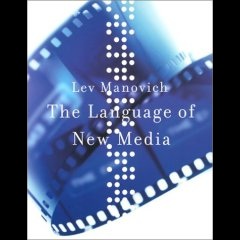
The Language of New Media by Lev Manovich (2001) Protocol: How Control Exists After Decentralization  by A R Galloway (2004) Everyware: The Dawning Age of Ubiquitous Computing  by Adam Greenfield (2006)
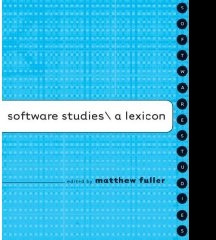
Software Studies: A Lexicon edited 
by Matthew Fuller (2008)
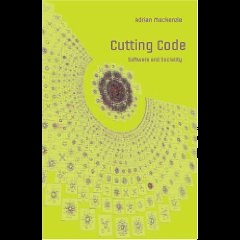
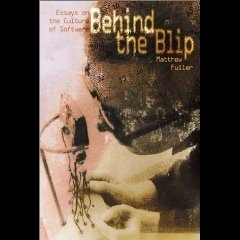
Cutting Code: Software and Sociality by Adrian Mackenzie (2006) Behind the Blip: Essays on the Culture of Software by Matthew Fuller (2003)

Last updated:  7th July 2009.